TOI-199 b, a rare temperate giant planet, sits between scorching hot Jupiters and frozen gas giants, and JWST has found methane in its atmosphere. That first close look begins to fill a major gap in planetary chemistry, while raising questions.
Methane is common on the cold giants of our solar system, but it has been missing from one important middle ground: giant planets warm enough to be temperate, yet not roasted by their stars. That gap has now narrowed with a close look at TOI-199 b, a Saturn-sized world more than 330 light-years away.
The planet circles its star every 105 days and has an estimated temperature of about 175 degrees Fahrenheit. That is still hot by everyday standards, but far milder than the blistering “hot Jupiters” that dominate many exoplanet atmosphere studies and far warmer than Jupiter and Saturn, which sit in deep cold far from the sun.
Using NASA’s James Webb Space Telescope, researchers analyzed the atmosphere of TOI-199 b and found strong evidence for methane. The result makes the planet one of the few known temperate giant exoplanets studied this closely, and the first of its kind to have its atmosphere characterized in detail. The work was led by researchers at Penn State and NASA’s Jet Propulsion Laboratory and published in The Astronomical Journal.
“One of the main advantages of studies of planets beyond our solar system, known as exoplanets, is the ability to study many different types of planets, especially ones that we don’t see in the solar system, to learn about how planetary systems form and evolve,” said Renyu Hu, associate professor of astronomy and astrophysics at Penn State and leader of the research team.
TOI-199 b sits in a part of planetary science that has been strangely hard to explore. Hot Jupiters are easier to study because they whip around their stars quickly, transit often, and have puffed-up atmospheres that leave clearer signals in starlight. Cooler giant planets with longer orbits are much less cooperative.
That matters because temperate giants are expected to host chemistry unlike either extreme. At these lower temperatures, methane should become the main carbon-bearing molecule, while ammonia may also be present. Water, unlike on colder giants, may remain in vapor form rather than condensing out. That combination gives astronomers a chance to examine carbon, nitrogen, and oxygen in a planetary atmosphere under conditions that fall between Titan, Jupiter and the hottest gas giants.
To read that atmosphere, the team used transmission spectroscopy. As TOI-199 b crossed in front of its star, a small fraction of starlight passed through the planet’s atmosphere before reaching JWST. Molecules in the atmosphere absorb specific wavelengths, leaving behind a pattern that can be read like a fingerprint.
“As a planet passes in front of its star, some of the star’s light passes through the planet’s atmosphere where it interacts with the elements and molecules in the atmosphere,” said Aaron Bello-Arufe, a postdoctoral researcher at JPL and the paper’s first author. “Specific elements will absorb specific wavelengths of light, creating a fingerprint in the spectrum of light that JWST detects that reflects the atmosphere’s composition.”
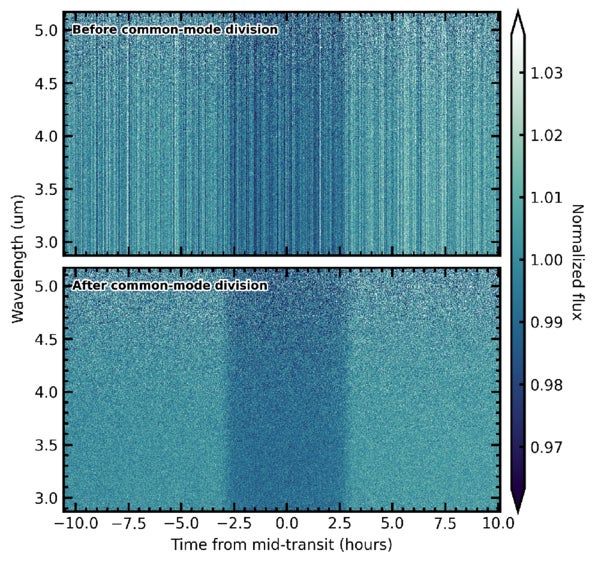
The observation itself did not go smoothly. During target acquisition, JWST failed to lock onto the intended source properly. The team believes the telescope likely caught only the far wings of the science target’s point-spread function, or perhaps a diffraction spike. That left the data much noisier than expected, with uncertainties about four to five times larger than predicted.
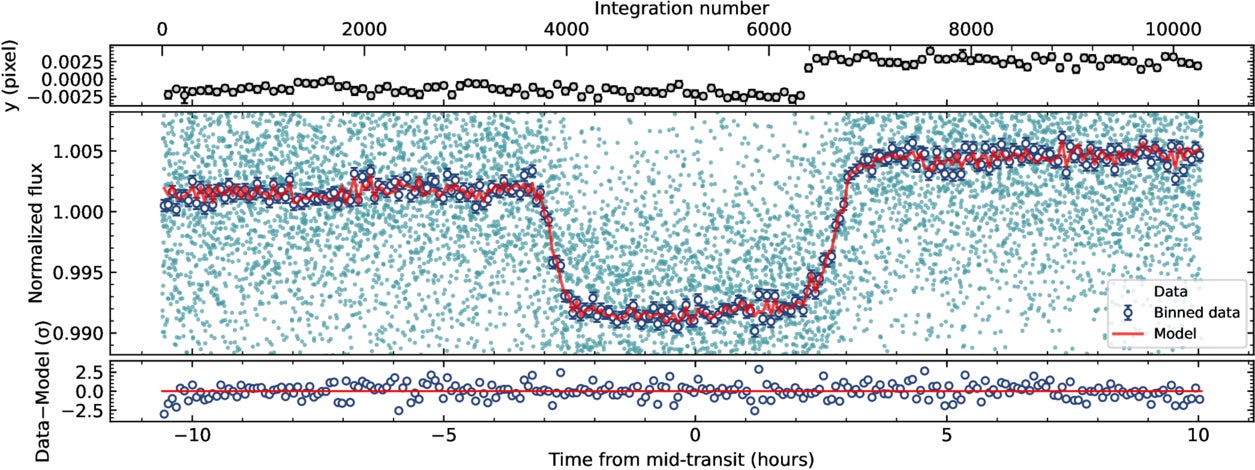
Even so, the researchers were able to salvage a useful spectrum. They ran two independent data-reduction pipelines and found that both produced broadly consistent results. The transit lasted about seven hours, far longer than the brief transits typical of hot Jupiters, and the full observing sequence stretched to about 20 consecutive hours to establish a clean baseline for the host star.
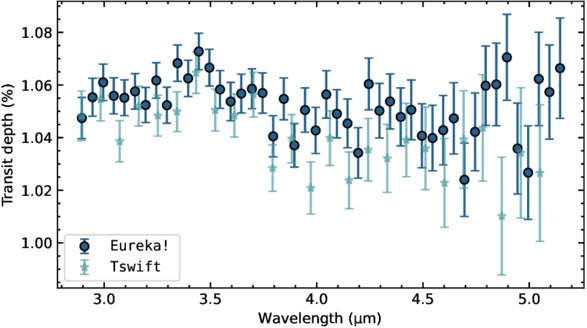
When the team compared the transit spectrum with the baseline starlight, methane stood out. That mattered not only because the signal was strong, but because theory had predicted it should be there.
“When we compared the spectra during the transit to the baseline, we saw that the atmosphere blocked the wavelengths of starlight absorbed by methane,” Bello-Arufe said. “Models for the composition of temperate, gas-giant exoplanets had predicted that they would contain methane, so it is good to get confirmation that our theories are accurate.”
The retrieval analyses pointed to decisive evidence for methane, while ammonia, carbon dioxide, hydrogen cyanide and other gases remained far less certain. The data offered hints of ammonia and carbon dioxide, but not enough to claim firm detections. Clouds and hazes also remain unresolved. The current spectrum can be explained by several atmospheric setups, though methane remains the clearest result across models.
That first detection does more than fill in a chemical box. The abundance of methane can help researchers estimate the planet’s metallicity, while upper limits on carbon monoxide and carbon dioxide help rule out some hotter or more metal-rich atmospheric scenarios. The team’s self-consistent photochemical models suggest TOI-199 b likely avoids the most extreme metallicities because those would push carbon monoxide and carbon dioxide above the observed limits.
The planet’s atmosphere may also offer a way to study nitrogen chemistry in a regime that has few direct examples. In equilibrium, ammonia should dominate the nitrogen budget. But ultraviolet light from the star can break apart nitrogen-bearing molecules and help create hydrogen cyanide instead. How much ammonia survives, and how much hydrogen cyanide builds up, depends in part on vertical mixing inside the atmosphere.
That is where the new study leaves some of its most interesting open questions. The observations are good enough to show methane clearly, but not yet precise enough to distinguish cleanly among ammonia, hydrogen cyanide, clouds and hazes, or to pin down how strongly the atmosphere is being mixed from deeper layers upward.
The team also used new JWST and TESS data to refine the timing of TOI-199 b’s transits and improve the orbital picture of the broader planetary system. That analysis did not change the mass of TOI-199 b from earlier work, so the atmospheric conclusions stayed intact, but it did sharpen estimates for the system’s second known planet and produced transit predictions through the end of 2040.
The immediate value of the result is that it opens a new category of exoplanets to atmospheric study. For years, hot Jupiters have dominated because they were easiest to observe. TOI-199 b shows that a temperate giant, even with a difficult dataset, can still reveal meaningful chemistry.
“With additional observations of this planet, we could establish the relative abundance of these various gases in its atmosphere,” Hu said. “This more complete picture of a temperate gas giant’s atmosphere can then be used to improve our models and potentially better understand how planets and their atmospheres form and evolve, including for Earth. The success of this first study of a temperate giant planet’s atmosphere also gives us confidence to dedicate more resources and observation time to study other similar planets. We can then see if this planet is unique or if there are general shared characteristics for this type of planet.”
Future JWST observations could sharpen the picture dramatically, especially if they avoid the target-acquisition problem that inflated the current uncertainties. Better spectra in the same 3 to 5 micron range could help separate ammonia from hydrogen cyanide, constrain carbon dioxide more tightly, and test how much vertical mixing shapes the atmosphere.
Shorter-wavelength observations could also help distinguish between a clear atmosphere, a cloudy one, and one shaped by hazes. In plain terms, TOI-199 b has become a test case for a class of planets astronomers have long expected, but had not yet truly opened up.
Research findings are available online in The Astronomical Journal.
The original story “JWST finds methane in the atmosphere of a rare temperate Saturn-sized planet” is published in The Brighter Side of News.
Like these kind of feel good stories? Get The Brighter Side of News’ newsletter.
The post JWST finds methane in the atmosphere of a rare temperate Saturn-sized planet appeared first on The Brighter Side of News.

