A quasar from the universe’s first 850 million years has started to look less like a distant pinprick and more like a real physical system. By catching it flickering over time, astronomers have traced the structure of matter swirling around one of the earliest known supermassive black holes. What they found deepens one of cosmology’s biggest puzzles.
The object, known as J0439+1634, sits at a redshift of 6.51. This means its light comes from a time just 850 million years after the Big Bang. Quasars are among the brightest objects in the universe, powered by supermassive black holes pulling in gas and dust. As that material spirals inward, it heats up and radiates enormous amounts of energy. Sometimes, it outshines the galaxy around it.
Many quasars have already been found from this early era, often called the cosmic dawn. What makes this one stand out is not just its age, but its variability.
“Although there have been a lot of quasars found in the cosmic dawn, this is the first time we actually see one flickering,” says Gene Leung, a postdoc in the MIT Kavli Institute for Astrophysics and Space Research.
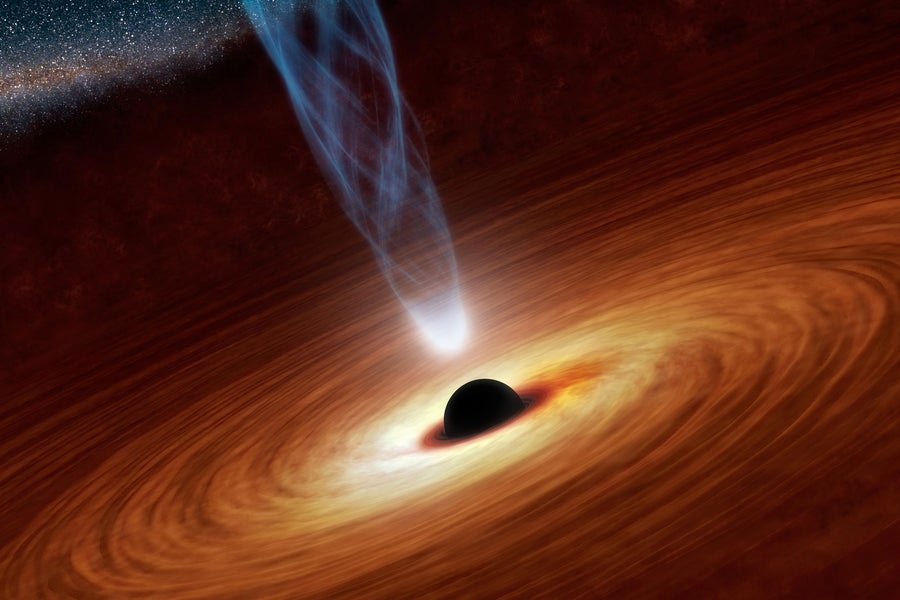
Nearby quasars are known to brighten and dim as the flow of gas into their central black holes changes. Those fluctuations can reveal how the accretion disk, the rotating disk of hot matter feeding the black hole, is built. But seeing that kind of behavior in the early universe is far harder.
Distance stretches light to longer, redder wavelengths, and it stretches time as well. As a result, a fluctuation that would play out over weeks in a quasar’s own frame can appear to take months when viewed from Earth. To catch that behavior, the team needed long-term infrared observations.
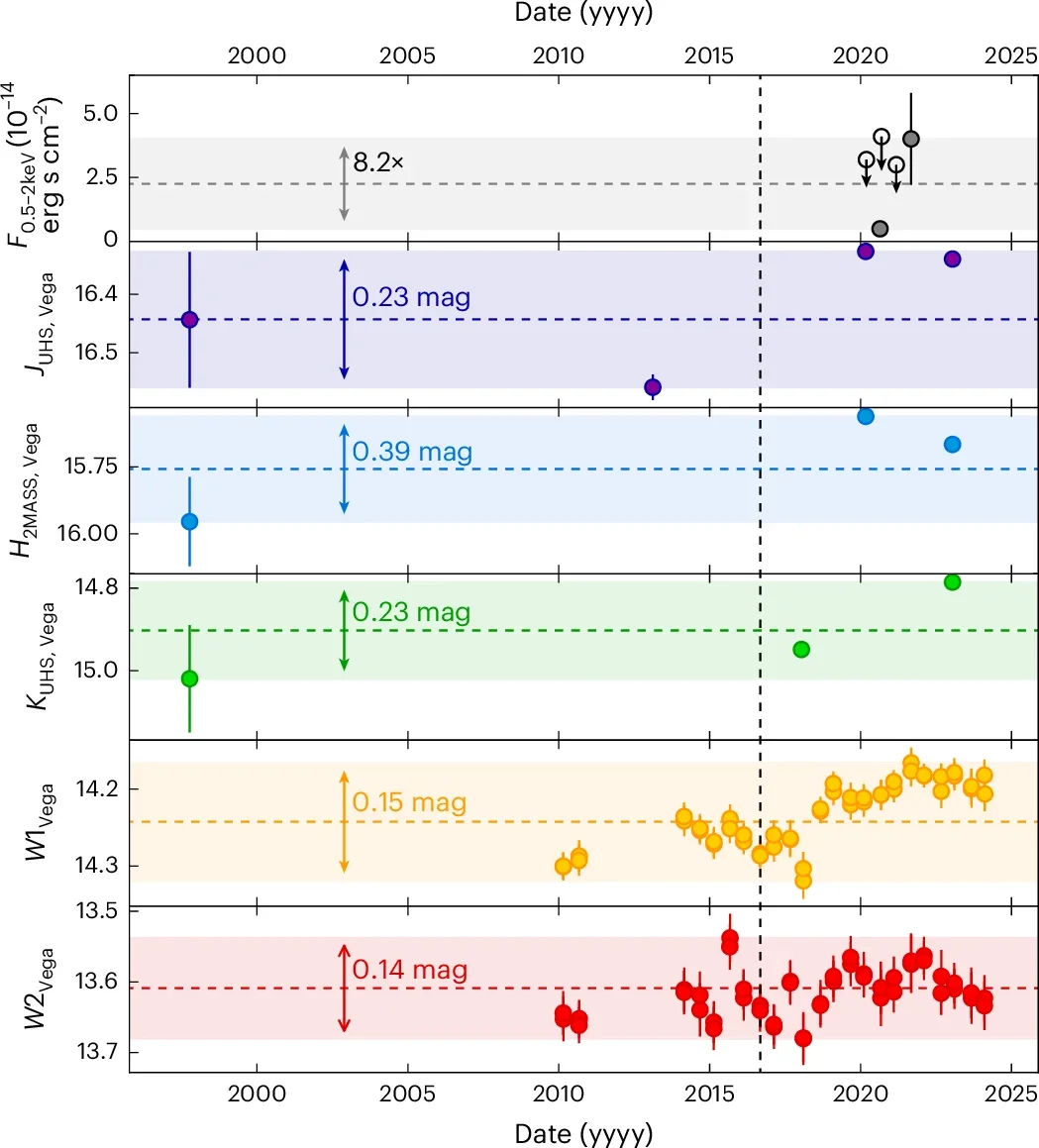
They found them in archival data from NASA’s Near-Earth Object Wide-field Infrared Survey Explorer, or NEOWISE, which repeatedly scanned the sky from 2010 to 2024. In reprocessed observations from that mission, the researchers identified clear changes in J0439+1634 over about 14 years.
“We saw the quasar flickering randomly over the 14-year period, much like a candle’s flame flickers without a fixed pattern,” Leung notes.
The quasar is estimated to shine with the brightness of 12 trillion suns. Over the monitoring period, its output changed by about 20 percent, or roughly 2 trillion suns. In the W1 infrared filter, the variability reached a significance of 10.9 sigma. The quasar also brightened in multiple infrared bands after about 2016. Moreover, its X-ray flux rose by 8.2 ± 3.7 times from mid-2020 to late 2021.
That flicker gave the team a way to map the quasar’s accretion disk across wavelengths. Because different wavelengths come from material at different temperatures, and therefore different distances from the black hole, the changing light acts like a probe of the disk’s shape.
The answer was unexpected. The variable spectrum matched what astronomers expect from a standard geometrically thin, optically thick accretion disk. The best-fit spectral slope was −1.58 ± 0.25, consistent with the thin-disk expectation of −4/3. It did not match the prediction for a slim disk, a puffier structure often associated with very high accretion rates.
That matters because J0439+1634 is not a sedate local black hole. After correcting for gravitational lensing, the quasar was found to host a black hole of (6.3 ± 0.2) × 10^8 solar masses. It is also accreting at (60 ± 10)% of the Eddington limit. In other words, it is growing rapidly in the early universe. Its growth occurs in conditions very different from those around nearby active galactic nuclei.
Yet its feeding disk looks surprisingly familiar.
“This provides direct evidence that the same feeding processes and structures observed in the nearby universe were already in place at very early times, despite very different cosmic environments, which had never been seen before,” Eilers says.
The finding sharpens a longstanding problem. Supermassive black holes were not expected to appear so soon after the Big Bang. Yet astronomers have now found more than 200 of them within the first billion years of cosmic history. If such objects had so little time to grow, many researchers expected their accretion flows to be more turbulent and less settled than those of later quasars.
Instead, this one appears remarkably mature.
“I think what this suggests is that all the messy, very rapid growth phases that we expect all black holes to go through at some point happen very, very early on, before we see them as these very bright luminous quasars,” says Anna-Christina Eilers, assistant professor of physics at MIT. “That’s the picture that’s emerging.”
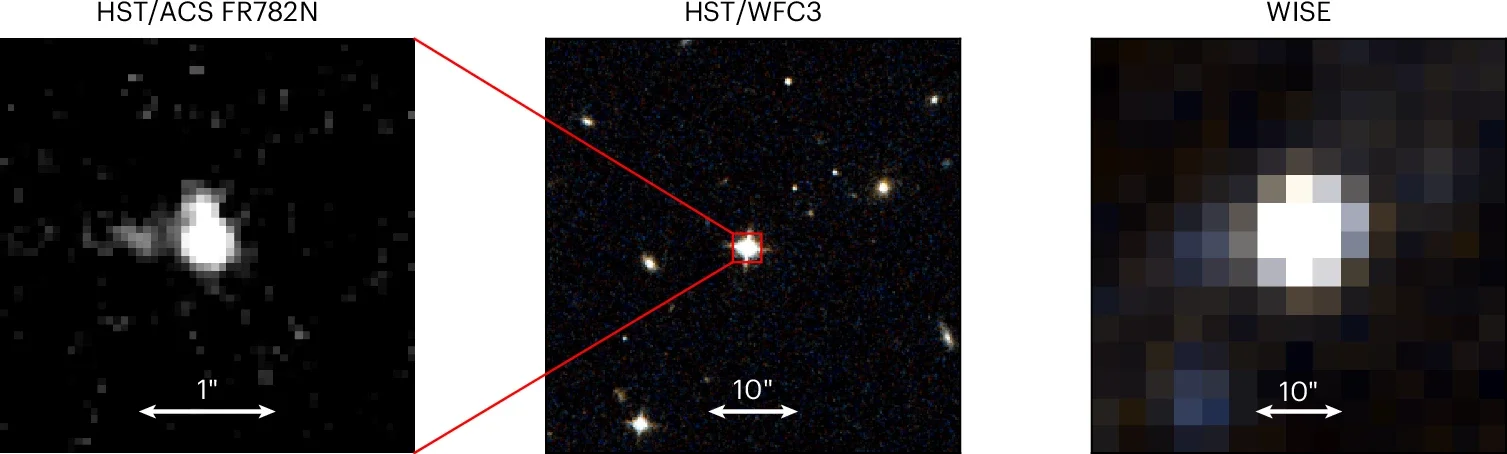
J0439+1634 is a gravitationally lensed quasar, meaning a foreground galaxy magnifies its light. That raised an obvious question: could the brightening be caused by microlensing rather than real changes in the quasar itself?
The team tested that possibility. Based on the source size and effective velocity in the lensing system, a microlensing event should last about 45 years in the observed frame. The main brightening seen here unfolded over about five years, from the W1 minimum in 2016 to the maximum in 2021. Given that mismatch, the authors favored intrinsic disk variability instead.
They also examined whether the timing of the changes fit known accretion-disk processes. The observed brightening spans about 1,830 days, which corresponds to about 240 days in the quasar’s rest frame. The shortest plausible timescale, the light-crossing time of the relevant part of a thin disk, is about 100 days. Orbital, thermal, and viscous timescales run much longer, from decades to far beyond the duration of the observations. That makes light-crossing scale reprocessing from a variable high-energy source the most likely explanation, much as in nearby quasars.
The work may also help with another stubborn problem: measuring black hole masses in the early universe. Those estimates usually rely on scaling relations built from nearby systems, and their validity at high redshift remains uncertain.
For J0439+1634, the researchers found no significant delay between two infrared bands within NEOWISE’s roughly 180-day cadence, placing a 90 percent upper limit of 160 days in the observed frame. Using the expected wavelength scaling for a thin disk, they inferred a rest-frame upper limit of less than 48 light-days for the relevant part of the disk. This is consistent with thin-disk predictions.
Because this quasar is strongly magnified by lensing, it may also be one of the best targets yet for reverberation mapping in the early universe. This is a method that could provide an independent black hole mass measurement. The authors argue that monitoring the compact accretion disk, rather than waiting for much longer broad-line region delays, could shorten the required timescale by about 100 times.
This finding gives astronomers a new way to study how the first supermassive black holes grew so quickly.
Instead of relying only on single snapshots of distant quasars, they can now use long-term variability to probe disk structure. This also allows them to test whether early black holes behaved like nearby ones.
The result also points to future surveys by the Roman Space Telescope and Rubin Observatory. These could find many more variable quasars from the early universe. In turn, they could help pin down how these giant black holes formed, fed, and reached enormous masses so soon after cosmic time began.
Research findings are available online in the journal Nature Astronomy.
The original story “MIT astronomers detect oldest known flickering quasar from the cosmic dawn” is published in The Brighter Side of News.
Like these kind of feel good stories? Get The Brighter Side of News’ newsletter.
The post MIT astronomers detect oldest known flickering quasar from the cosmic dawn appeared first on The Brighter Side of News.


Leave a comment
You must be logged in to post a comment.