Asteroid Donaldjohanson does not move through space with the tidy, steady spin scientists often expect. It tumbles in a more complicated way, and after NASA’s Lucy spacecraft swept past it in April 2025, that wobble turned into one of the most revealing clues yet about the asteroid’s rough history.
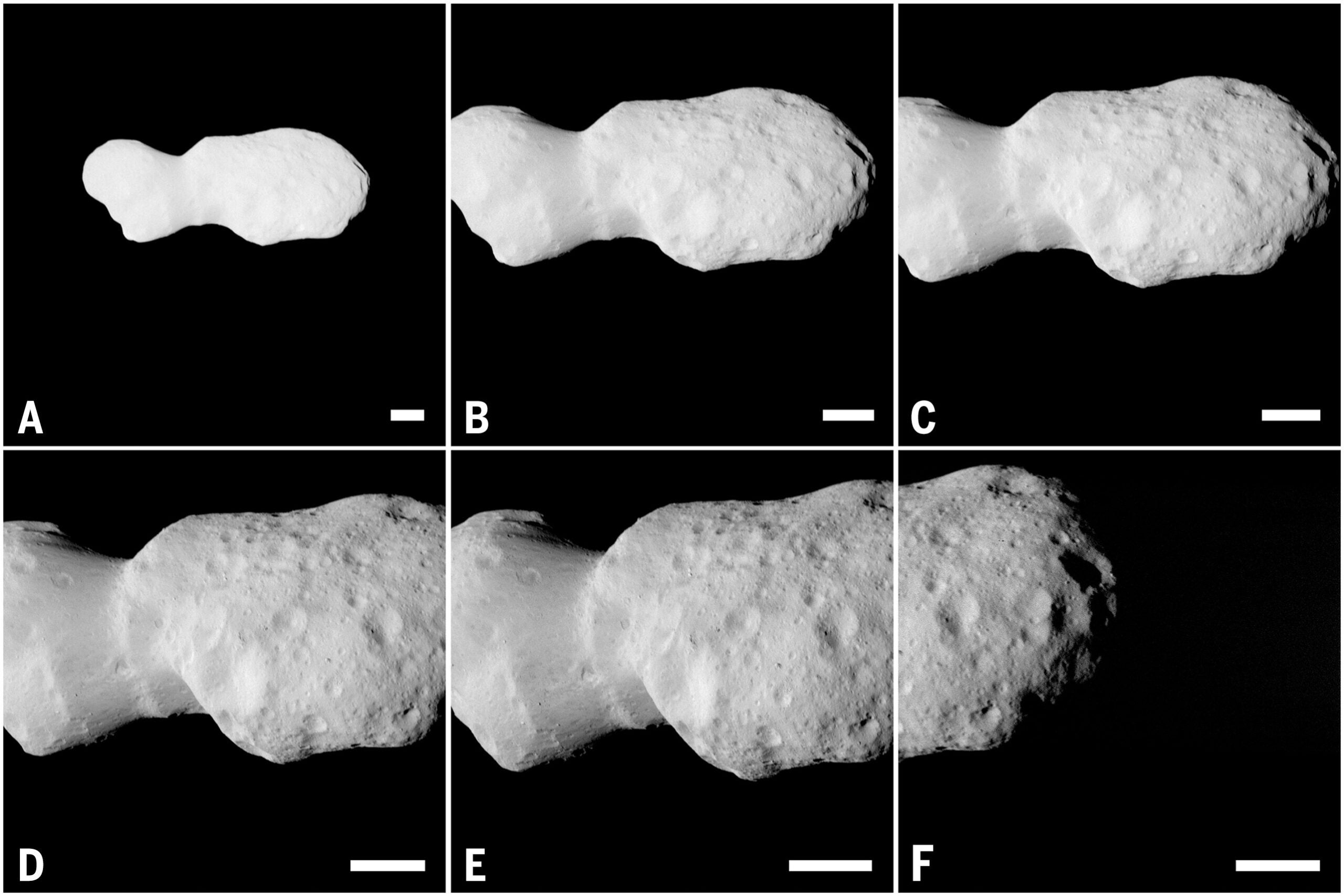
The small body, about half a mile wide, was already known as an unusual target. Earth-based observations had hinted at an elongated shape and a slow rotation. But Lucy’s close flyby showed something stranger and more vivid: Donaldjohanson looks like a peanut, made of two lobes connected by a narrower neck.
“This is just one of many surprising things learned since NASA’s Lucy spacecraft flew by Donaldjohanson on April 20, 2025,” said Southwest Research Institute’s Dr. Simone Marchi, deputy principal investigator of the Lucy mission and the study’s lead author.
Using images gathered during the 59 days before the encounter, the team found that the asteroid has a main rotation period of about 252.6 hours, or 10.5 Earth days. They also detected a second period of 455.2 hours, about 26.5 days. Together, those motions point to what scientists call non-principal axis rotation, meaning the object is not spinning neatly around one stable axis.
In plain terms, Donaldjohanson is wobbling.
That unstable motion is not just a curiosity. The analysis suggests the asteroid could keep tumbling this way for about 20 billion years, far longer than the age of the asteroid family it likely came from. That means once the wobble started, it had little reason to stop.
Donaldjohanson probably belongs to the Erigone asteroid family, a group thought to have formed when a much larger parent asteroid broke apart between 115 million and 225 million years ago, most likely around 155 million years ago. That breakup happened in the inner main belt, the crowded region between Mars and Jupiter.
The researchers say Donaldjohanson’s orbit, slow spin and low tilt are all consistent with long-term effects from sunlight. Over time, the uneven absorption and re-radiation of solar energy can gradually alter an asteroid’s spin and even shift its orbit. In this case, those subtle forces may have slowed the asteroid down and helped set up the conditions for its current odd rotation.
The flyby ruled out some simpler explanations. Donaldjohanson does not come close to planets, unlike some tumbling near-Earth asteroids whose spins can be disturbed during close passes. Lucy also found no sign of comet-like activity, and no moons or satellites were seen around it.
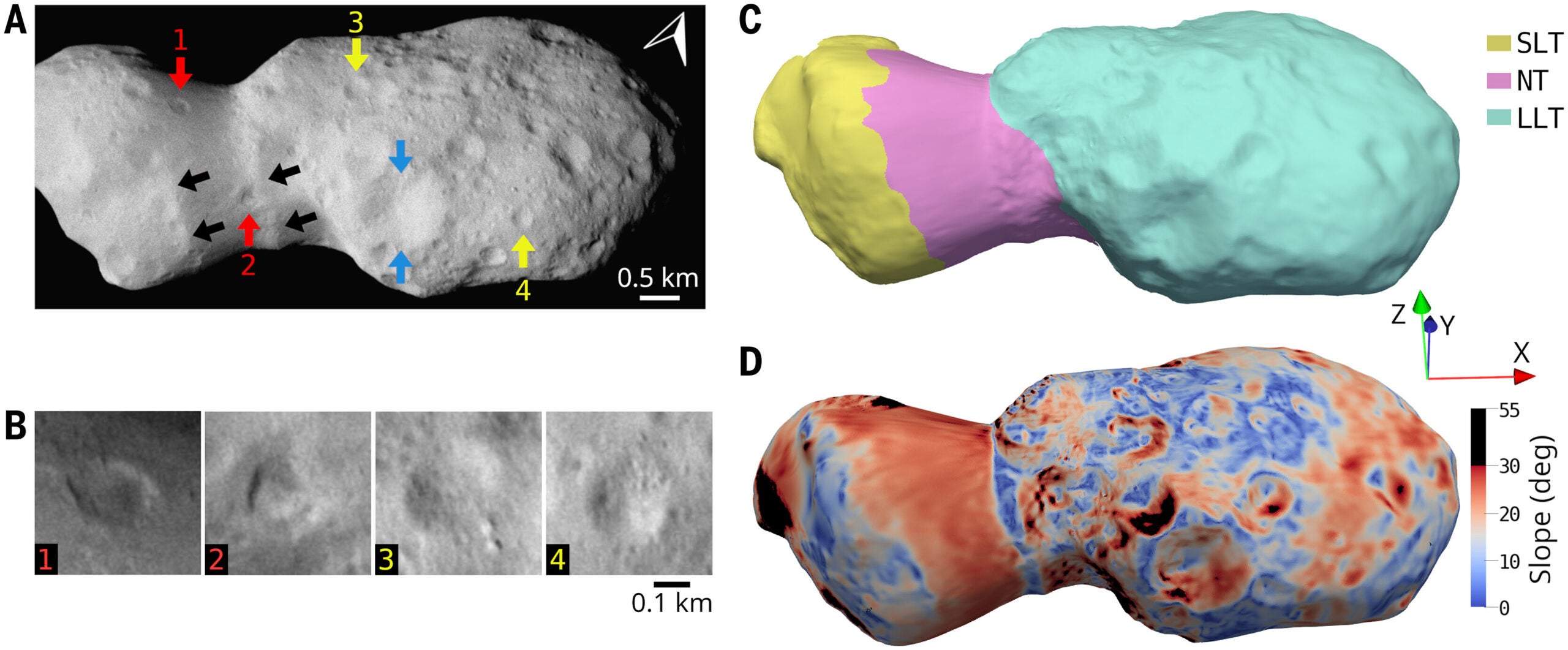
Lucy’s close-range images showed an object with a surprisingly varied surface. The best views, taken at a resolution of 5.2 meters per pixel, revealed three distinct terrains: two cratered lobes and a smoother neck region between them.
That neck appears to tell an important part of the story. It has a largely uniform slope averaging about 25 degrees, steep enough to suggest that loose material once moved across it. The team argues that the neck likely experienced one or more episodes of mass movement, with material shifting from the small lobe toward the large lobe and helping form a ridge.
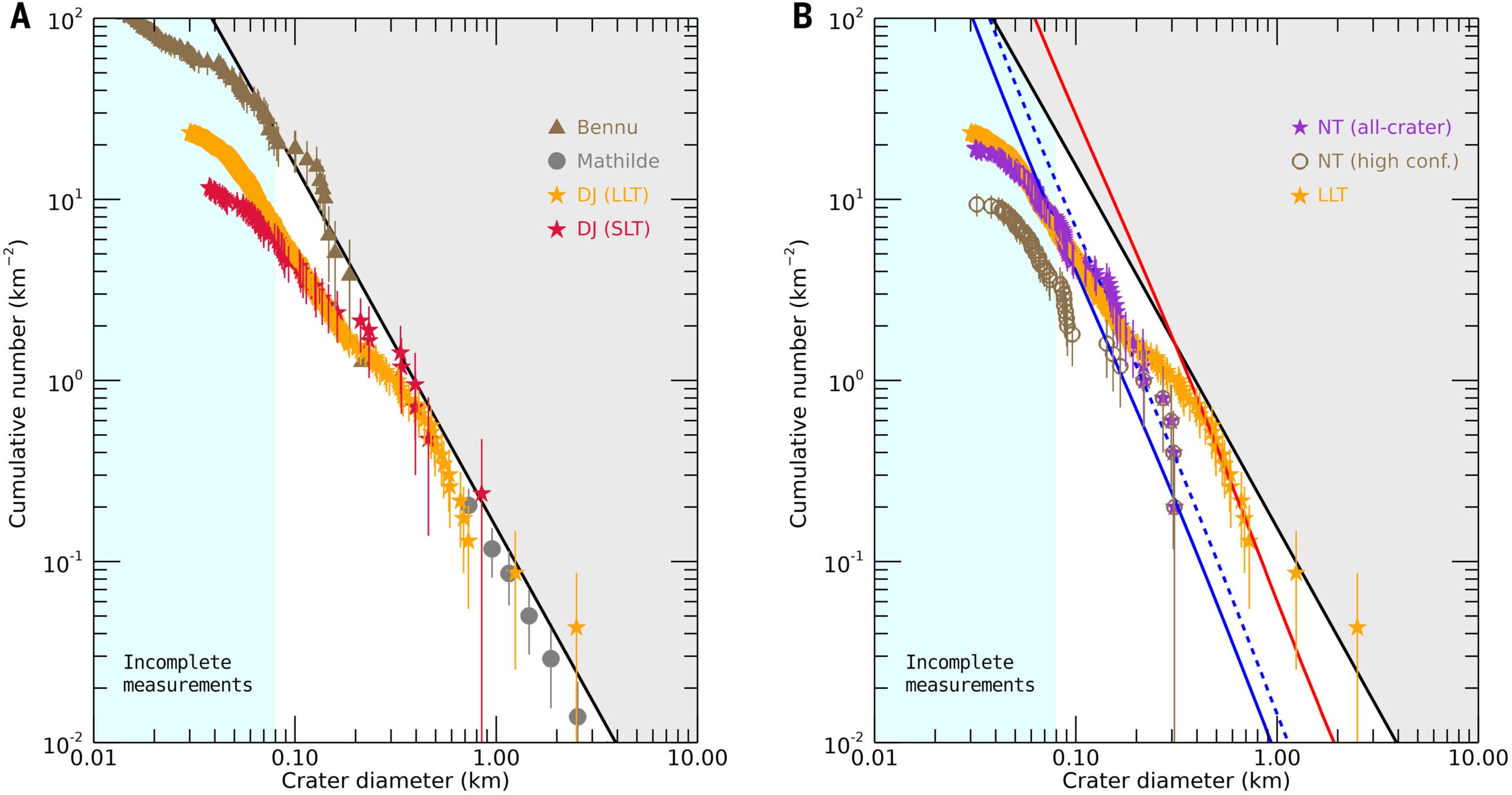
Elsewhere, the surface is heavily cratered, but not in a simple, unchanged way. The crater counts on the large and small lobes look similar, which suggests the two lobes share a common history. Yet smaller craters are scarcer than expected. The researchers conclude that craters smaller than about 0.4 kilometers were likely erased over time.
That erasing did not happen immediately after the asteroid formed. Based on crater counts and models of surface strength, the team estimates that many of the smaller craters disappeared within the last 20 to 40 million years. On the neck, some crater shapes look even more degraded, pointing to more recent local mass wasting, possibly within the last 20 million years.
The surface also seems stronger than those of Bennu and Ryugu, two rubble-pile asteroids that have become familiar from recent missions. Donaldjohanson has a similar carbon-rich composition, but its cratering behavior suggests a sturdier surface and perhaps a different interior structure.
Another clue came from Lucy’s infrared instrument, which detected a strong absorption feature at 2.790 micrometers. Combined with an earlier ground-based absorption band at 0.7 micrometers, the signal points to hydrated minerals, especially iron-rich phyllosilicates.
Those minerals form when rock interacts with liquid water.
That does not mean Donaldjohanson ever had flowing water on its surface. Instead, it suggests that the larger parent body from which it descended underwent aqueous alteration long ago. In other words, water once changed the minerals inside a bigger asteroid, and fragments of that altered body later became members of the Erigone family.
The researchers say Donaldjohanson’s spectrum closely matches some CM carbonaceous chondrite meteorites and differs from Bennu and Ryugu in an important way. Bennu and Ryugu appear to contain more magnesium-rich phyllosilicates, signs of more extensive alteration. Donaldjohanson’s iron-rich minerals suggest those reactions stopped earlier, perhaps because there was not enough water or heat to keep them going.
That difference hints that carbon-rich asteroids in the inner main belt did not all share the same internal history.
The team proposes a layered history for Donaldjohanson. A parent asteroid about 80 kilometers wide was smashed apart by an impactor roughly 20 kilometers across around 155 million years ago. Donaldjohanson may have formed as fragments from that breakup slowly re-accreted into a bilobed body. It probably began with a much faster spin than it has today.
Later, solar-driven torques slowed the asteroid and shifted its spin axis. As the rotation changed, slopes in the neck may have failed, sending material downslope and smoothing that region. At some point, an impact may have triggered seismic shaking that erased small craters across the surface. Eventually, the body entered the tumbling state Lucy sees today.
“This encounter gave us an opportunity to test our instruments and our procedures to make sure we are ready when we get to Jupiter’s Trojans,” Marchi said. “Once we start learning more about the Trojans, a completely different population of space rocks with very different histories, our understanding of solar system formation is likely to be challenged.”
That is why Donaldjohanson matters beyond its own strange shape. Lucy visited it as a practice run before heading to the Trojan asteroids that lead and trail Jupiter, objects thought to preserve much older material from the early solar system. Even this warm-up target has already shown that small worlds can keep long, messy records of collisions, internal change, shifting landscapes and ancient water.
The findings give mission scientists more than a curious asteroid biography. Donaldjohanson helped Lucy test its tracking system, imaging sequence and spectral instruments under real flyby conditions before the spacecraft reaches Jupiter’s Trojan swarms.
Scientifically, the asteroid offers a timed example of how small bodies can evolve after a family-forming collision. Because its parent family is relatively young, researchers can place tighter limits on when spinning slowed, when material moved across the surface and when smaller craters were erased.
The hydrated minerals also add to the evidence that some carbon-rich asteroids preserve signs of ancient water-driven chemistry, which helps scientists compare different asteroid families and refine ideas about how early solar system bodies formed and changed.
Research findings are available online in the journal Science.
The original story “NASA’s Lucy spacecraft finds asteroid Donaldjohanson is tumbling through space” is published in The Brighter Side of News.
Like these kind of feel good stories? Get The Brighter Side of News’ newsletter.
The post NASA’s Lucy spacecraft finds asteroid Donaldjohanson is tumbling through space appeared first on The Brighter Side of News.


Leave a comment
You must be logged in to post a comment.