A supernova remnant is supposed to be a rough neighborhood for a newborn star. Shock waves rip through space at thousands of kilometers per second. Cosmic rays and X-rays flood nearby gas. Rare elements get tossed into the surrounding clouds.
Yet inside one of these violent leftovers, astronomers have found something unexpectedly delicate still holding together.
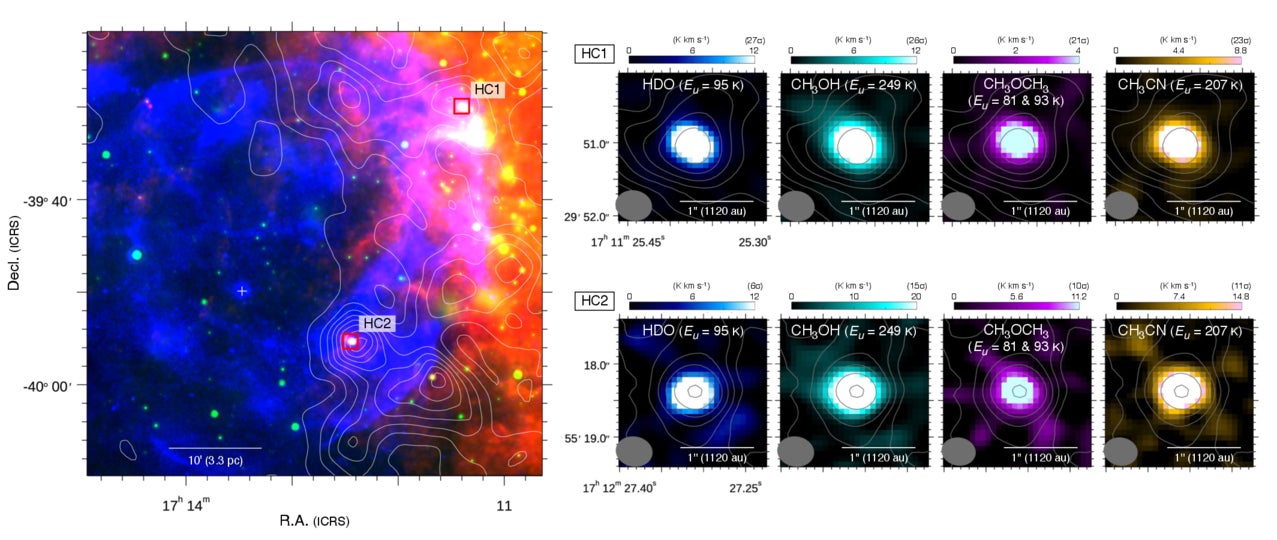
Using the Atacama Large Millimeter/submillimeter Array, or ALMA, a team in Japan identified two warm, dense cocoons of gas around infant stars inside the supernova remnant RX J1713.7−3946. These objects, known as hot cores, are rich in molecules linked to the chemistry of star and planet formation. According to the team, this is the first time hot cores have been detected inside a supernova remnant.
The finding, published in The Astrophysical Journal, suggests that even after a massive nearby star explodes, some newborn stars may stay wrapped tightly enough in their natal material to protect a surprisingly rich chemical inventory.
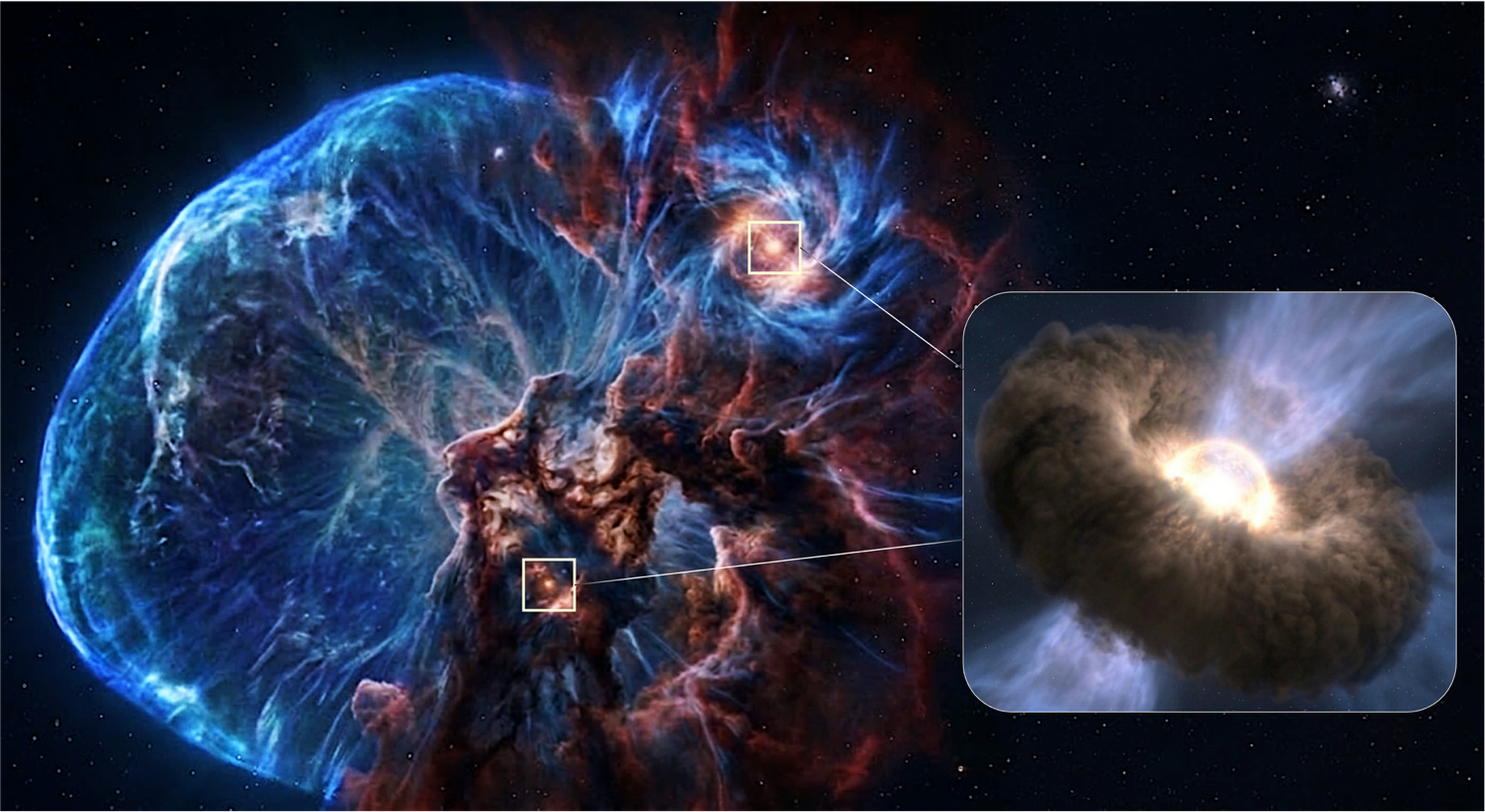
“These observations indicate that even in the harsh environment of a supernova remnant, newborn stars can remain well protected within their natal cocoons, preserving their rich molecular composition,” said lead author Takashi Shimonishi, an astronomer at Niigata University in Japan. “The environments capable of harboring complex organic molecules, potential building blocks of prebiotic chemistry, may be more diverse than previously recognized.”
The target of the study, RX J1713.7−3946, is the remnant of a massive star that exploded about 1,600 years ago. It lies roughly 1.12 kiloparsecs from Earth, or a little more than 3,600 light-years away, and is known as a high-energy remnant associated with dense molecular clouds.
That made it a compelling place to ask a long-standing question in astronomy: What happens to the raw chemistry of star and planet formation when a supernova goes off nearby?
Researchers have suspected for years that the early Solar System may have formed in a region shaped by a nearby supernova. Clues come from isotopic oddities preserved in meteorites and asteroid material, which appear to record unusual conditions in the Sun’s birth environment. But whether supernova feedback helps build chemical complexity or strips it away has remained uncertain.
Hot cores offer a way to check. These compact regions around young protostars are dense, warm, and chemically active. Many complex organic molecules are thought to form earlier on icy dust grains, then enter the gas phase as the dust warms. If a supernova strongly disrupts that process, the chemistry inside a hot core should show it.
Instead, one of the two newly found hot cores looked strikingly ordinary.
The team detected a broad mix of molecules in the source known as RX 1713 HC1. The list included carbon-, oxygen-, nitrogen-, sulfur-, and silicon-bearing species, along with complex organic molecules containing up to nine atoms. Among them were methanol, dimethyl ether, methyl formate, ethanol, acetaldehyde, ethyl cyanide and formamide.
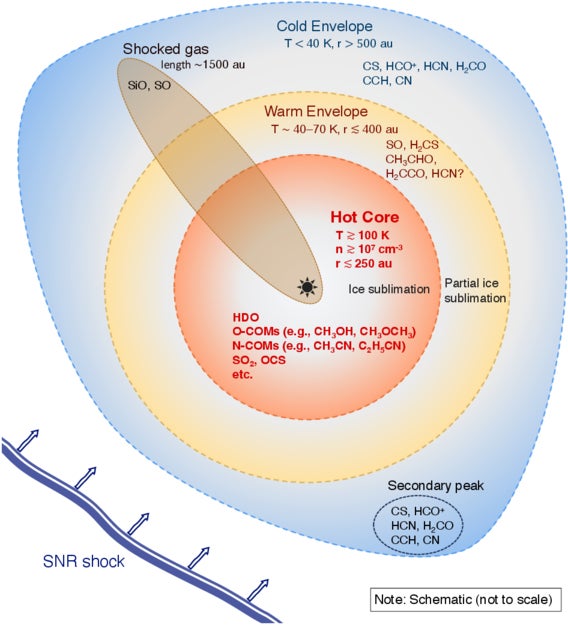
Many of the detected lines came from high-temperature gas. The compact source sizes, high densities and temperatures above 100 kelvin all point to a real hot core, not just a cold clump of gas lit from afar. The researchers also estimated bolometric luminosities of 260 times the Sun’s luminosity for HC1 and 230 for HC2, consistent with intermediate-mass Class I protostars.
What stood out most was not simply that these molecules existed, but that their relative abundances did not look badly damaged.
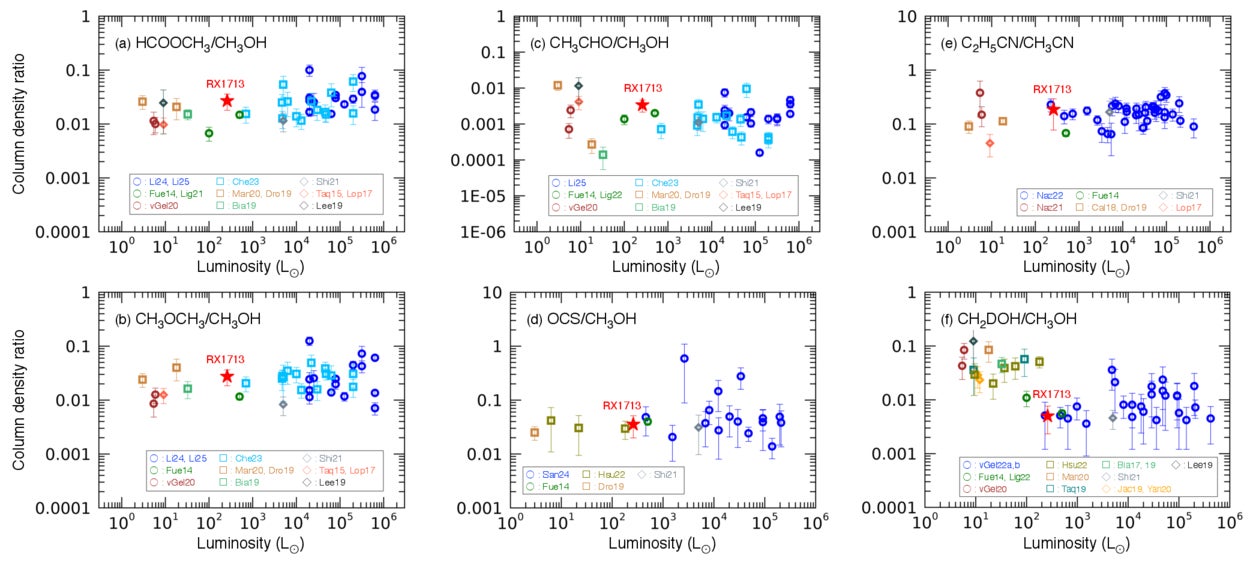
When the team compared HC1 with known hot cores and hot corinos in more ordinary star-forming regions, the molecular ratios lined up remarkably well. The chemistry of major complex organic molecules, sulfur-bearing molecules and nitrogen-bearing species did not show major deviations from what astronomers see in calmer places. Even the deuterium enrichment of methanol, often a sign of cold earlier conditions, was in the same range as similar objects elsewhere.
That result matters because the environment around RX J1713 is anything but calm. Earlier work suggests the region is exposed to cosmic-ray ionization rates roughly 10 to 100 times above standard molecular cloud values. X-ray studies have also found shock speeds of about 1,000 to 4,000 kilometers per second.
In theory, such conditions could tear molecules apart, especially after ices have evaporated into gas. But in HC1, the chemistry still appears intact.
The researchers offer two main explanations.
One is timing. HC1 may have only recently started feeling the full effects of the supernova. The protostar itself likely existed before the explosion, since hot core phases generally last around 10,000 to 100,000 years, much longer than the remnant’s estimated age of 1,600 years. If the surrounding material has been exposed to the harshest radiation and energetic particles for less than about 1,000 years, there may simply not have been enough time to remake its chemistry.
The second possibility is shielding.
The team notes that magnetic fields amplified by the supernova shock could reduce how effectively cosmic rays penetrate the dense gas. The hot core’s own column density is also substantial. Together, those conditions may help block or weaken the destructive influence of energetic particles before they reach the core’s center.
There are hints that the remnant is pressing on the region. The progenitor lies to the southeast of HC1, and the dust structure on that side appears sharply compressed. Some molecular lines also show wing-like features that may trace outflows, jets or shocked gas. But those signs do not yet amount to clear chemical damage in the hot core itself.
The result leaves astronomers with an intriguing middle ground. Supernova feedback may still matter greatly, but its impact could depend on timing, geometry, shielding and the exact evolutionary stage of the star-forming material.
The authors are careful not to overstate the case. This is one system, and mainly one detailed chemical analysis, HC1. The second hot core, HC2, sits much closer in projected distance to the likely progenitor, about 4 parsecs away compared with roughly 10 parsecs for HC1. That means HC2 may have spent longer under harsher exposure, and its chemistry could turn out differently.
Future observations will be needed to learn whether molecular resilience inside supernova remnants is common or exceptional.
That broader question reaches beyond one remnant in our galaxy. If young stars can preserve rich organic chemistry even after a nearby supernova, then the range of places where prebiotic ingredients survive may be wider than astronomers assumed. It also gives fresh weight to the idea that the Solar System itself may have formed in a similarly turbulent setting without losing the raw material needed for later chemical complexity.
This study gives astronomers a real-world test case for how star and planet formation proceeds under extreme conditions. Instead of relying only on simulations or laboratory chemistry, researchers now have evidence that complex organic molecules can survive inside protected protostellar cocoons even within a supernova remnant.
That could change how scientists think about the environments that can support planet-building chemistry, including the one that produced the Solar System.
It also points to a new target for future observations: star-forming cores at different distances from supernova remnants, where exposure time and shielding may reveal when chemistry stays intact and when it begins to change.
Research findings are available online in The Astrophysical Journal.
The original story “Organic molecules can survive violent supernova explosions – fueling star and planet formation” is published in The Brighter Side of News.
Like these kind of feel good stories? Get The Brighter Side of News’ newsletter.
The post Organic molecules can survive violent supernova explosions – fueling star and planet formation appeared first on The Brighter Side of News.


Leave a comment
You must be logged in to post a comment.