Orion is about as familiar as a patch of sky gets. Visible without a telescope, studied by nearly every major instrument ever pointed at the heavens, mapped and catalogued across centuries of astronomy. What could possibly be left to find?
Quite a lot, it turns out.
An international team led by Juan Diego Soler at the University of Vienna has produced the sharpest maps ever made of neutral atomic hydrogen in the Orion Nebula. The images look nothing like what the standard picture predicted. Expanding shells, previously invisible cavities, and a mysterious elongated structure of gas jutting outward from the main bubble—none of it was there in older observations. Moreover, the mass of the whole surrounding shell, which previous studies put at roughly one thousand times that of the Sun, now appears to be nearly ten times lower.
That is not a small correction. It rewrites something fundamental about how efficiently young massive stars reshape the space around them.
Hydrogen is by far the most common element in the universe, but neutral atomic hydrogen is effectively invisible to optical telescopes. It does not glow in visible light. It cannot be photographed. What it does is emit a faint radio signal at a very specific wavelength: 21 centimeters. That signal, predictable and constant, is the fingerprint that radio astronomers use to trace the otherwise dark gas drifting between stars.
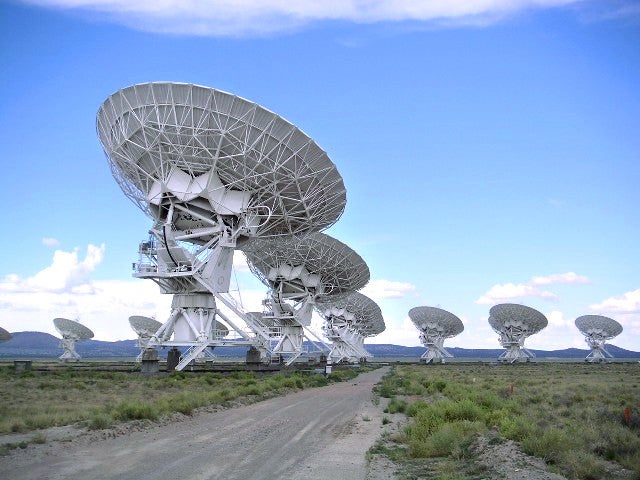
To detect that emission in the Orion Nebula with unprecedented clarity, Soler’s team combined data from two of the most powerful radio facilities on Earth. One is the Karl G. Jansky Very Large Array in New Mexico, a network of 27 large dish antennas that can be arranged to simulate a telescope kilometers across. The other is the Five-hundred-meter Aperture Spherical Radio Telescope in China. It is a single massive dish carved into a natural depression in the landscape, the largest filled-aperture radio telescope ever built.
Used together, the two instruments complement each other. The VLA resolves fine spatial detail. FAST captures faint, extended emission that smaller dishes miss. The result was 21-centimeter maps of the Orion Nebula region with a clarity that had not been achieved before.
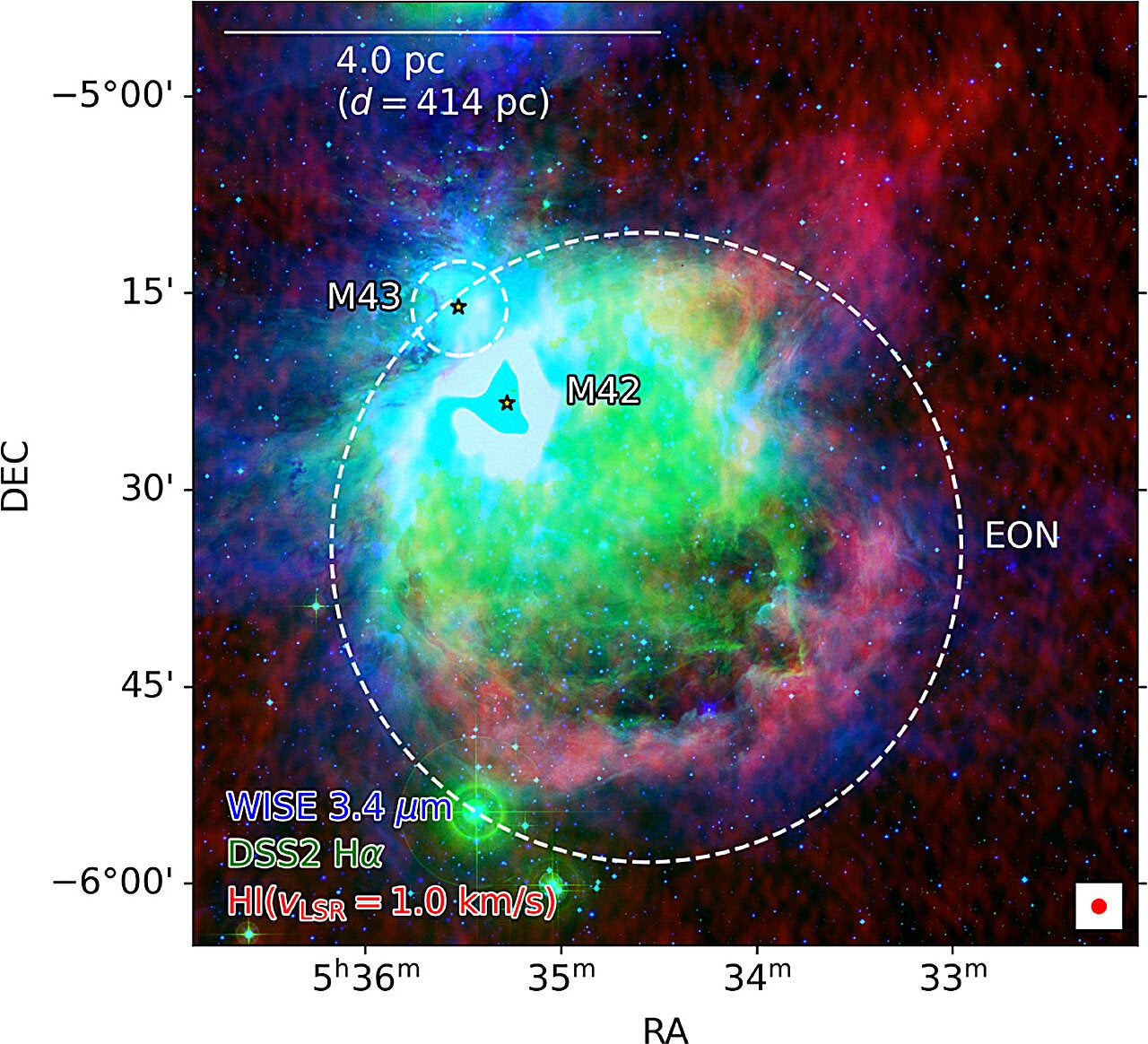
The conventional picture of the Orion Nebula‘s surroundings described a single expanding shell of gas, inflated by the radiation and stellar winds of the young, massive stars at its center. However, the new hydrogen maps complicate that picture substantially.
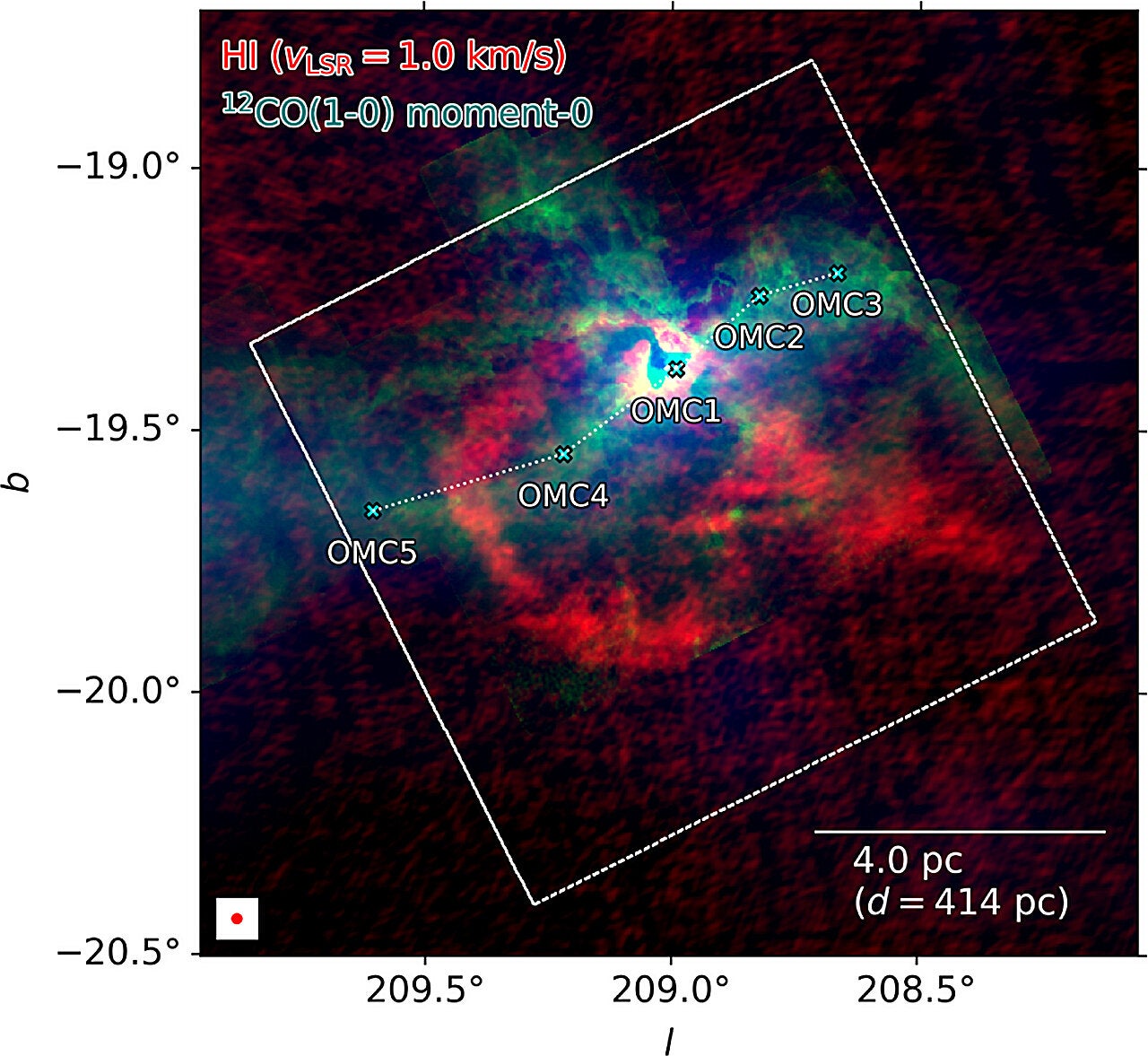
Inside the main shell, the observations reveal what appears to be a second, independent expanding cavity. Outside it, an elongated protrusion of atomic gas extends roughly four light-years outward from the bubble’s edge. These features do not fit neatly into a story involving one event, one source, and one expanding sphere.
“These stunning observations serve as a reference for many modern astrophysical simulations investigating the evolution of gas and stars in the Milky Way,” said Daniel Seifried, a co-author of the study and researcher at the University of Cologne. “These are the kind of images that challenge the theoretical models and numerical simulations that we use to understand how massive stars affect their immediate surroundings.”
The evidence now points to a messier history: multiple episodes of stellar feedback, each leaving its own mark on the surrounding gas, layered over time into the complex structure the new maps reveal.
The revision to the shell’s mass is not merely a technical update. Mass is the currency of star-forming regions. It determines how much raw material is available for new stars to form. It also determines how efficiently existing stars are reshaping their neighborhood, and how the energy from stellar winds and radiation has been absorbed or dispersed.
“Measuring mass is fundamental,” Soler said, “because it tells us about the efficiency of these newly formed stars shaping their environment with wind and radiation.”
A factor-of-ten difference in the mass estimate changes what the models are being asked to explain. If the shell is far lighter than previously thought, then the stars at the center of the nebula are not pushing as much material around as the old calculations assumed. This changes the energy budget, the timescales, and the likely history of the whole region.
The Orion Nebula is not just a beautiful target. It is the closest region of massive star formation to Earth. This proximity makes it the reference point against which star-formation models have been tested and calibrated for decades. Therefore, when the reference changes, the models have to follow.
“These stunning observations serve as a benchmark,” Seifried added. Simulations that were built to reproduce the old picture of Orion will need to be revisited.
The new results are the first scientific output from a broader project called NeAtHood, based at the University of Vienna and funded by the Austrian Science Fund. The initiative aims to map neutral atomic hydrogen across multiple nearby star-forming regions. By doing so, it builds a picture of how that gas connects the different phases of the interstellar medium, from diffuse clouds to dense stellar nurseries.
Orion was the test case. The methods developed here will be applied elsewhere. This will include regions that are less thoroughly studied and potentially hiding even more unexpected structure.
“Orion is only the beginning,” Soler said. “Our newly developed methods show how future interferometers will reveal the hidden structure and dynamics of the interstellar medium, even in regions that astronomers already believed they understood well.”
Claire Murray, a co-author from the Space Telescope Science Institute in Baltimore, framed the broader significance: “This study is an exciting demonstration of the power of latest-generation radio telescopes to uncover new pieces to the star formation puzzle.”
Star formation theory is the foundation on which most of modern astrophysics rests. Understanding how gas clouds collapse into stars, how those stars then push back against their surroundings, and how that feedback influences the next generation of star formation is essential for modeling the evolution of galaxies across cosmic time.
The discovery that even a well-studied nearby nebula contains structures and mass estimates substantially different from current models is a direct challenge to those simulations. It suggests that the resolution and sensitivity of earlier radio observations were masking important physics, and that many other regions studied with older instruments may also be hiding comparable complexity.
The combined VLA-FAST observing strategy developed for this project also sets a template for future surveys. As next-generation radio facilities come online in the coming years, the methods refined here will allow astronomers to bring similar clarity to regions that are farther away, more obscured, or simply harder to observe, extending the reach of neutral hydrogen mapping across a much broader swath of the galaxy.
For now, the Orion Nebula, the most observed star-forming region in the sky, has just become a more interesting puzzle.
Research findings are available online in the journal Astronomy and Astrophysics.
The original story “Radio observations reveal once hidden structures around the Orion Nebula” is published in The Brighter Side of News.
Like these kind of feel good stories? Get The Brighter Side of News’ newsletter.
The post Radio observations reveal once hidden structures around the Orion Nebula appeared first on The Brighter Side of News.


Leave a comment
You must be logged in to post a comment.