Researchers at the University of Stuttgart have created a synthetic cell-like structure that can control the movement of molecules and organize complex chemical reactions using programmable DNA components. The work marks a major step toward building artificial systems that behave more like living cells.
The new platform uses two dynamic DNA-based pores embedded in a membrane to regulate molecular transport inside a tiny artificial compartment. Scientists call the system a “double-necked synthetic cell microreactor,” or DCM.
The project brought together researchers from the University of Stuttgart, the University of Michigan and Arizona State University. Their goal was ambitious. They wanted to recreate some of the coordinated behavior that allows living cells to survive, communicate and carry out complex tasks.
Living cells constantly move molecules through membrane channels and pores. These transport systems help cells exchange signals, trigger reactions and organize internal structures. Scientists have long tried to mimic those abilities using synthetic materials, but recreating the coordination found in biology has remained difficult.
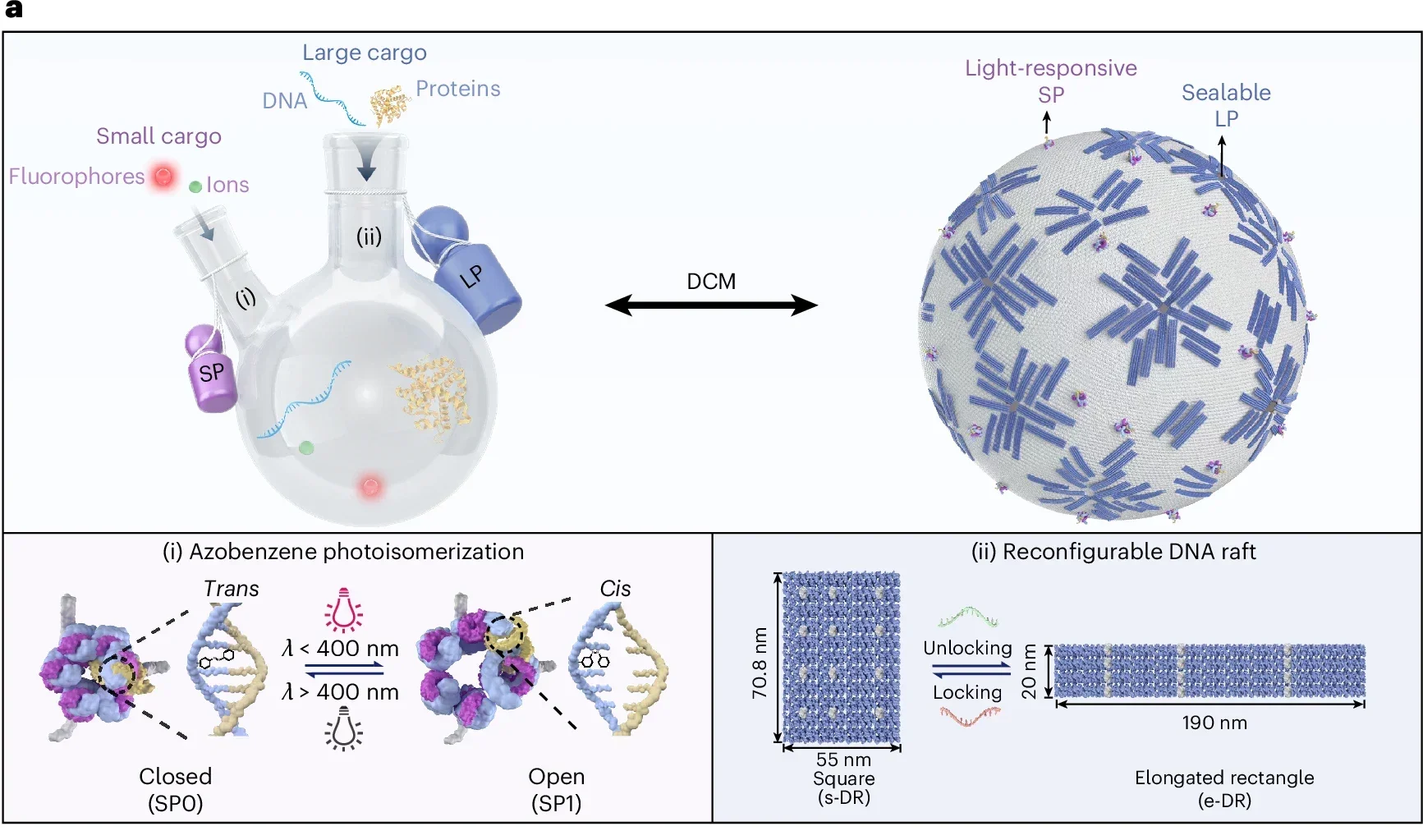
“The activation of a nanopore can trigger the formation of a second type of pore. This allows us to control molecular transport and biochemical reactions within the artificial compartment,” said Laura Na Liu, head of the 2nd Physics Institute at Stuttgart.
Biological systems depend on constant communication between molecular parts. Inside living organisms, proteins, membranes and signaling molecules interact across many scales. Those interactions allow cells to adapt, repair themselves and organize chemical activity with remarkable precision.
“The double-necked synthetic cell microreactor illustrates how principles of collective organization can begin to be transferred into synthetic systems,” said Thomas Speck, head of the Institute for Theoretical Physics IV.
The DCM starts with a giant unilamellar vesicle, or GUV, which acts like a simplified artificial cell membrane. The vesicle is made from lipids, the same type of material found in biological membranes.
Inside this membrane, researchers inserted two different DNA-based nanopores. One is a small pore called SP. The other is a larger pore called LP. Together, they work like coordinated gateways that determine which molecules enter and leave the artificial cell.
The smaller pore measures about 12.5 nanometers tall and contains a narrow opening roughly 2 nanometers wide. Researchers designed it with a light-sensitive DNA “lid” that changes shape when exposed to ultraviolet light.
When UV light shines on the system, the pore opens. When visible light appears, the pore closes again. This gives scientists direct control over membrane transport.
Tests showed that fluorescent molecules could only move into the vesicle while the pores remained open. When researchers switched the pores back to the closed state, transport stopped almost immediately.
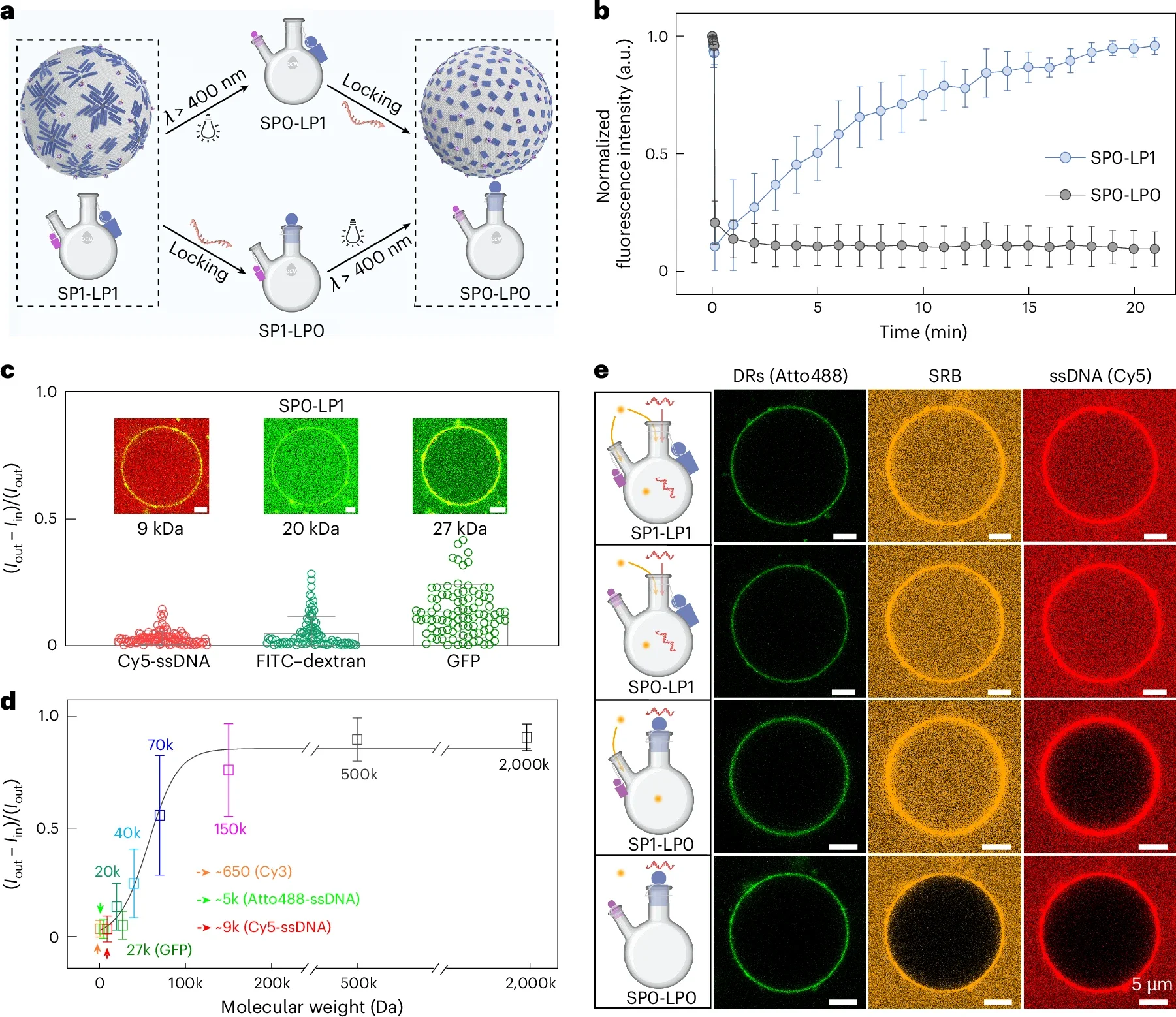
The small pores also transported calcium ions on command, showing the system could regulate both molecules and ions with precision.
The larger pore system works differently. Instead of responding directly to light, it forms through a coordinated signaling process involving DNA origami structures attached to the membrane surface.
These DNA rafts begin as compact square-like structures. After receiving special DNA unlocking strands, they transform into long rectangular shapes. That structural change bends and deforms the membrane.
At first, the membrane remains distorted because the small pores are still sealed. Once ultraviolet light opens the SPs, however, small solutes move through the membrane and restore osmotic balance. The vesicle returns to its original spherical shape.
Only then do the larger pores form.
This sequence creates a coordinated communication pathway between the two pore systems. One pore activates conditions that allow the second pore to emerge.
Researchers confirmed the LPs could transport much larger molecules, including proteins and large DNA strands. The large pores remained stable for at least two days.
The system can also exist in four different permeability states, depending on whether each pore type is open or closed. That flexibility allows researchers to control transport with far greater complexity than previous synthetic membrane systems.
The DCM does more than transport molecules. Researchers also used it as a tiny programmable reaction chamber capable of carrying out multistep biochemical processes.
One experiment recreated an enzyme cascade inside the vesicle. In living organisms, enzyme cascades allow reactions to occur in sequence, where one reaction triggers the next.
Scientists first trapped glucose oxidase inside the vesicle. They then delivered additional reactants step by step through the DNA pores. The controlled sequence allowed the reactions to unfold in an organized way.
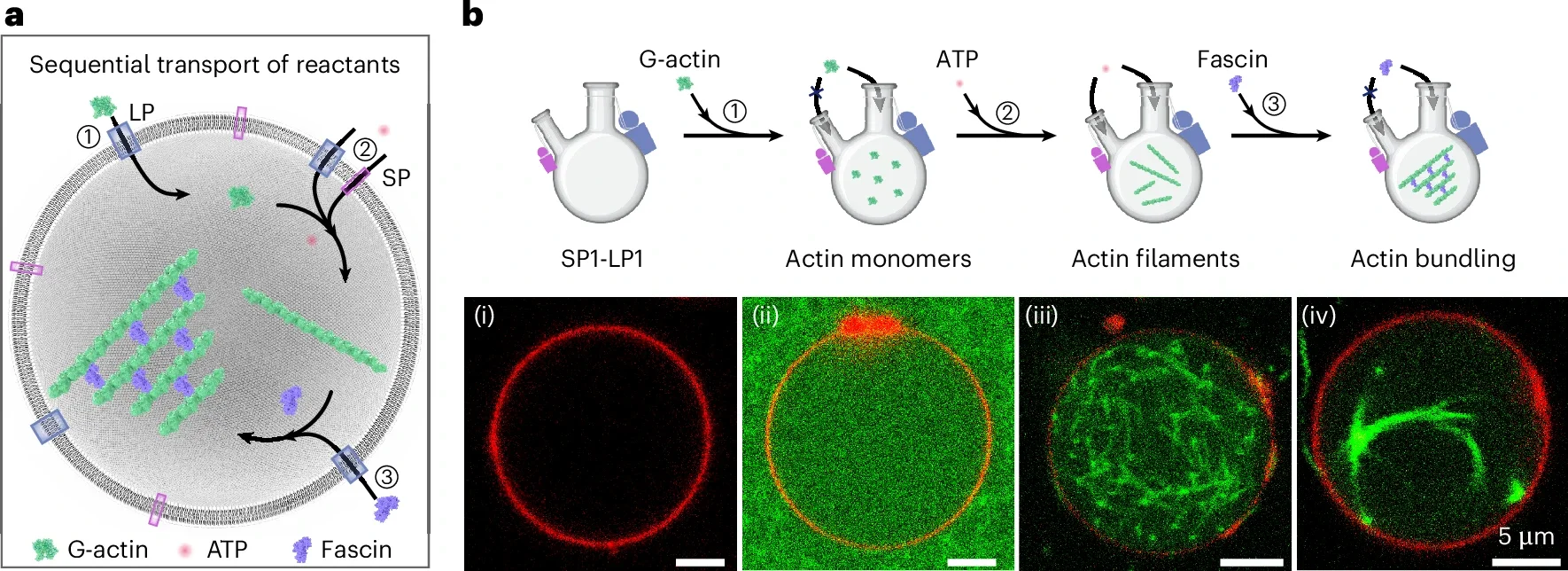
Another experiment rebuilt actin polymerization, one of the key structural processes inside living cells. Actin proteins help cells maintain shape, move and organize internal structures.
Researchers first transported actin building blocks into the vesicle through the large pores. They later introduced ATP, which triggered polymerization into long filaments. Finally, they added fascin, a protein that bundles actin fibers together.
The resulting structures resembled elements of a biological cytoskeleton.
The researchers also demonstrated controlled RNA transcription inside the synthetic compartment.
To achieve this, they trapped T7 RNA polymerase inside the vesicle and later introduced DNA templates and transcription materials through the pores. After sealing the compartment, the system produced Spinach RNA, a fluorescent RNA aptamer.
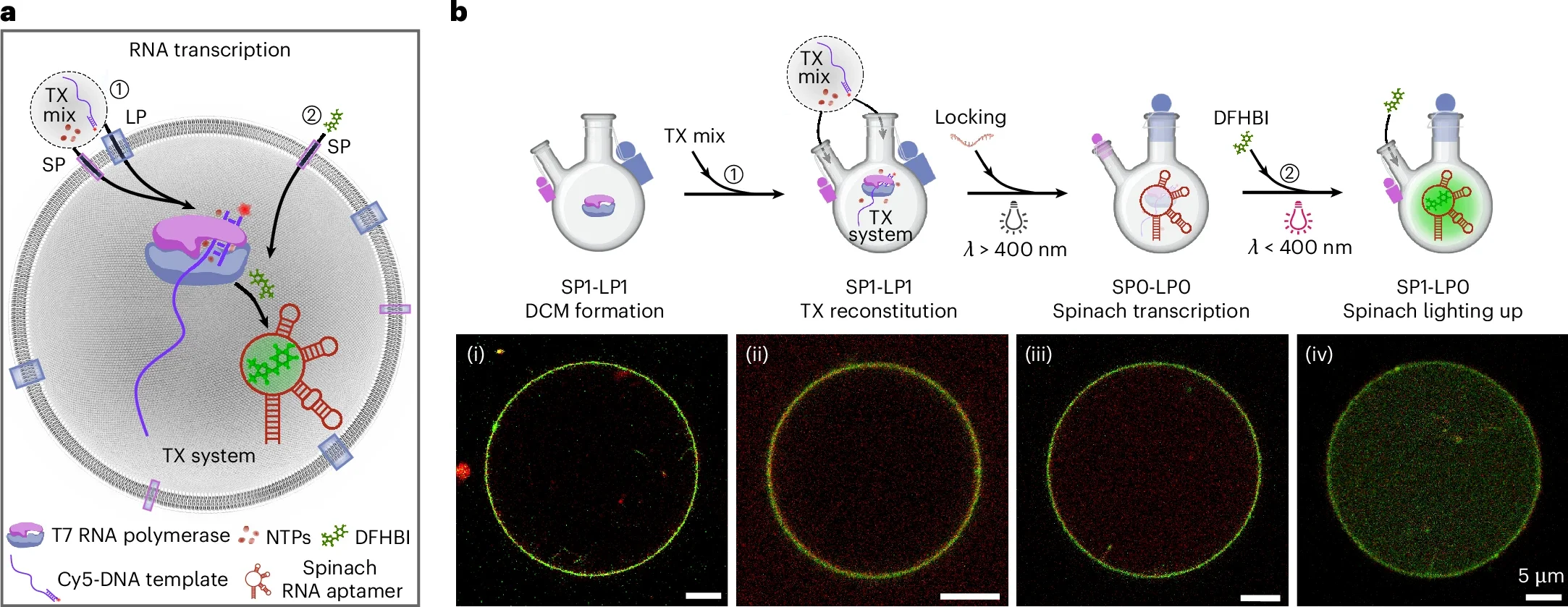
When researchers later reopened the small pores and added a fluorescent molecule called DFHBI, the vesicle glowed green. The fluorescence confirmed that gene-expression-like activity had taken place inside the synthetic cell.
The system even supported the confined growth of three-dimensional DNA crystals.
Scientists delivered DNA triangle motifs into the vesicle and carefully controlled magnesium ion concentrations using the pore system. Over two days, many vesicles produced single DNA crystals with highly organized structures.
In nearly 73% of tested vesicles, only one crystal formed inside the compartment. Researchers said the confined environment encouraged controlled nucleation while preventing chaotic growth.
The study highlights the growing power of DNA nanotechnology, a field that uses DNA not just as genetic material but also as a programmable building material.
Over recent years, Liu’s research group has developed several approaches for engineering dynamic DNA structures on membranes. The DCM builds on that work by introducing coordinated communication between synthetic components.
“The next frontier is no longer simply constructing structures, but programming how synthetic components interact, communicate, and collectively organize functionality,” Liu said.
Researchers believe systems like the DCM could eventually support programmable biochemical manufacturing, artificial organelles and self-organizing synthetic entities capable of carrying out sophisticated chemical tasks.
“Dynamically regulated reaction environments could open new possibilities for programmable biochemical synthesis and artificial entities capable of organizing complex multistep processes autonomously,” said Stephan Nussberger.
This research could help scientists build artificial systems that mimic important functions of living cells without relying on natural biological machinery. By controlling molecular transport and biochemical reactions with programmable DNA structures, researchers may eventually create synthetic microreactors capable of producing medicines, biomaterials or nanoscale devices with high precision.
The work also offers new tools for studying how cells organize themselves. Because the DCM allows scientists to control reactions step by step, it may provide a simpler platform for understanding membrane dynamics, molecular signaling and collective biological behavior.
In the future, programmable synthetic cells could support advances in biotechnology, medicine and materials science. Researchers may use similar systems to build artificial tissues, targeted drug delivery systems or miniature biochemical factories that operate autonomously inside controlled environments.
Research findings are available online in the journal Nature Chemistry.
The original story “Scientists build synthetic cells with programmable DNA pores” is published in The Brighter Side of News.
Like these kind of feel good stories? Get The Brighter Side of News’ newsletter.
The post Scientists build synthetic cells with programmable DNA pores appeared first on The Brighter Side of News.

