Far beneath the thick blue clouds of Uranus and Neptune, matter may behave in ways never before seen. Under crushing pressures and searing heat, carbon and hydrogen could organize into a bizarre new state that blurs the line between solid and liquid.
Researchers from Carnegie Science now believe they have found evidence for this hidden phase through advanced computer simulations. Their work predicts the existence of a “quasi-one-dimensional superionic” state of carbon hydride deep inside ice giant planets and possibly in massive worlds beyond our Solar System.
The discovery opens a new chapter in planetary science. It also offers fresh clues about how giant planets move heat, conduct electricity and generate magnetic fields.
“Our work shows that even simple combinations of elements can organize into surprisingly complex states under extreme conditions,” said Cong Liu, one of the study’s authors.
Uranus and Neptune may appear calm from afar, but their interiors are violent environments. Beneath their hydrogen and helium atmospheres lie deep layers of compressed “hot ices” made from water, methane and ammonia.
These are not frozen ices like those found on Earth. Extreme conditions transform them into dense, exotic forms of matter. Scientists believe pressures inside these planets can reach millions of times Earth’s atmospheric pressure. Temperatures can climb above 10,000 degrees Fahrenheit.
Researchers have long suspected that strange phases emerge under these conditions. Understanding them matters because the internal behavior of matter shapes how planets evolve over billions of years.
As astronomers discover more exoplanets, interest in planetary interiors has exploded. More than 6,000 exoplanets are now known. Scientists want to understand how their hidden layers influence planetary heat flow, magnetic fields and even long-term habitability.
To investigate these mysteries, Carnegie scientists Cong Liu and Ronald Cohen turned to high-performance computing and machine-learning tools. They simulated carbon hydride, or CH, under pressures ranging from 500 to 3,000 gigapascals. That equals roughly 5 million to 30 million times Earth’s atmospheric pressure.
They also modeled temperatures between 4,000 and 6,000 Kelvin, which is about 6,740 to 10,340 degrees Fahrenheit.
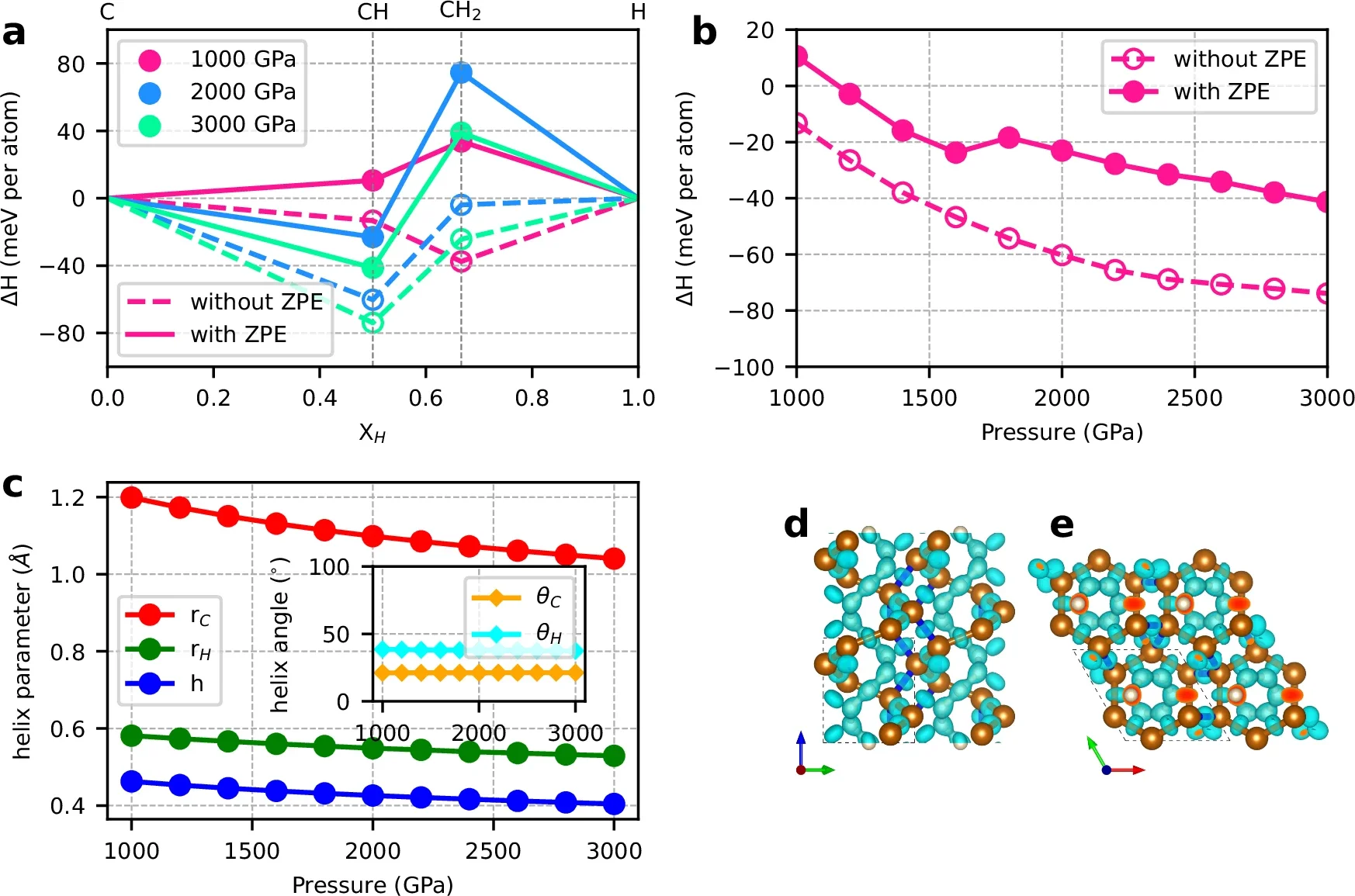
Using quantum physics calculations, the researchers searched for stable atomic arrangements. What they found surprised them.
At pressures above about 1,100 gigapascals, carbon hydride formed an unusual helical crystal structure. Carbon atoms locked into an ordered framework while hydrogen atoms arranged themselves into twisting spiral chains.
The structure resembled tiny intertwined springs stretching through the material.
“This newly predicted carbon-hydrogen phase is particularly striking because the atomic motion is not fully three-dimensional,” Cohen explained. “Instead, hydrogen moves preferentially along well-defined helical pathways embedded within an ordered carbon structure.”
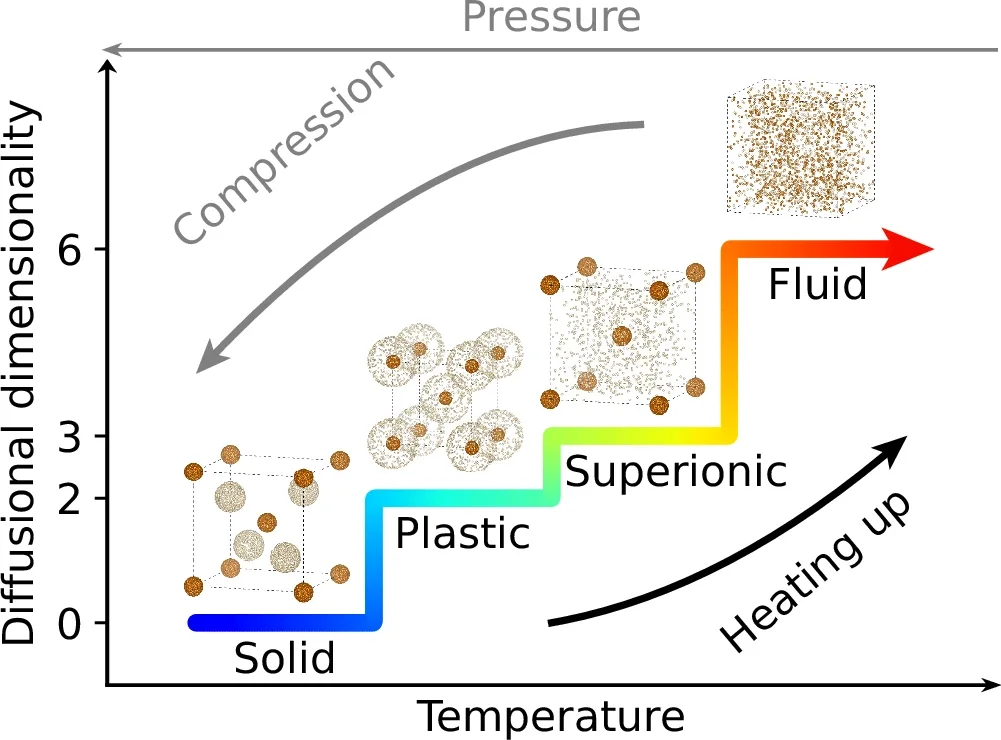
The new phase belongs to a rare category called superionic matter. Superionic materials exist somewhere between solids and liquids. One type of atom stays fixed in a crystal structure while another moves freely through it.
Scientists have studied superionic phases before, especially in water-rich planetary materials. But this newly predicted version behaves differently.
In the carbon hydride phase, hydrogen atoms do not move equally in all directions. Instead, they mainly travel along spiral pathways running through the carbon framework.
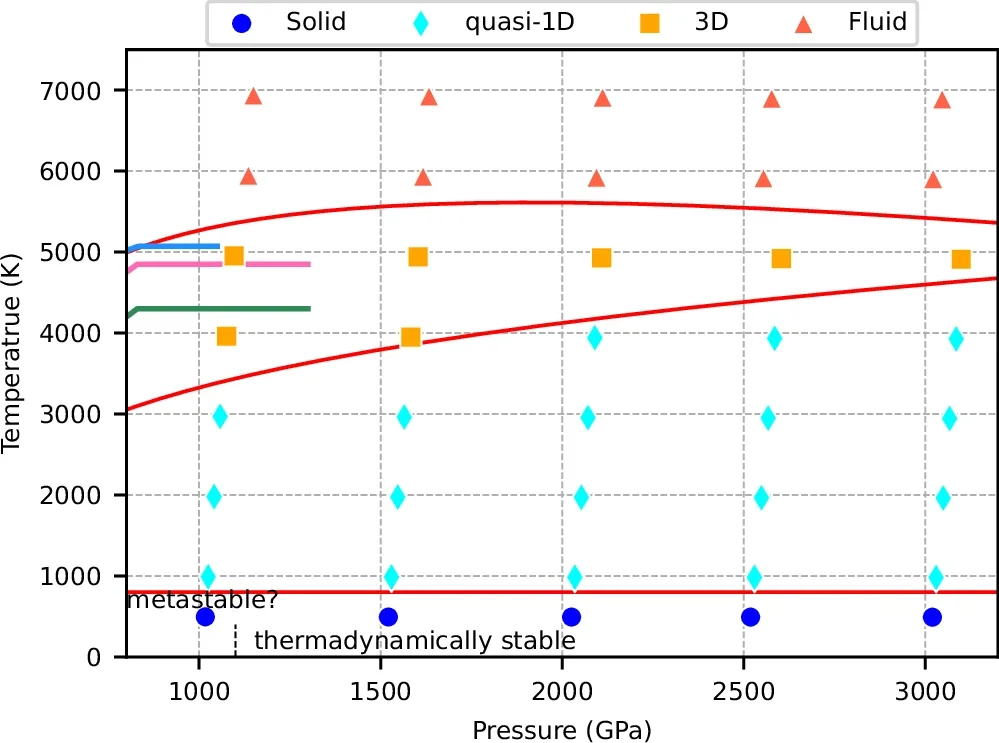
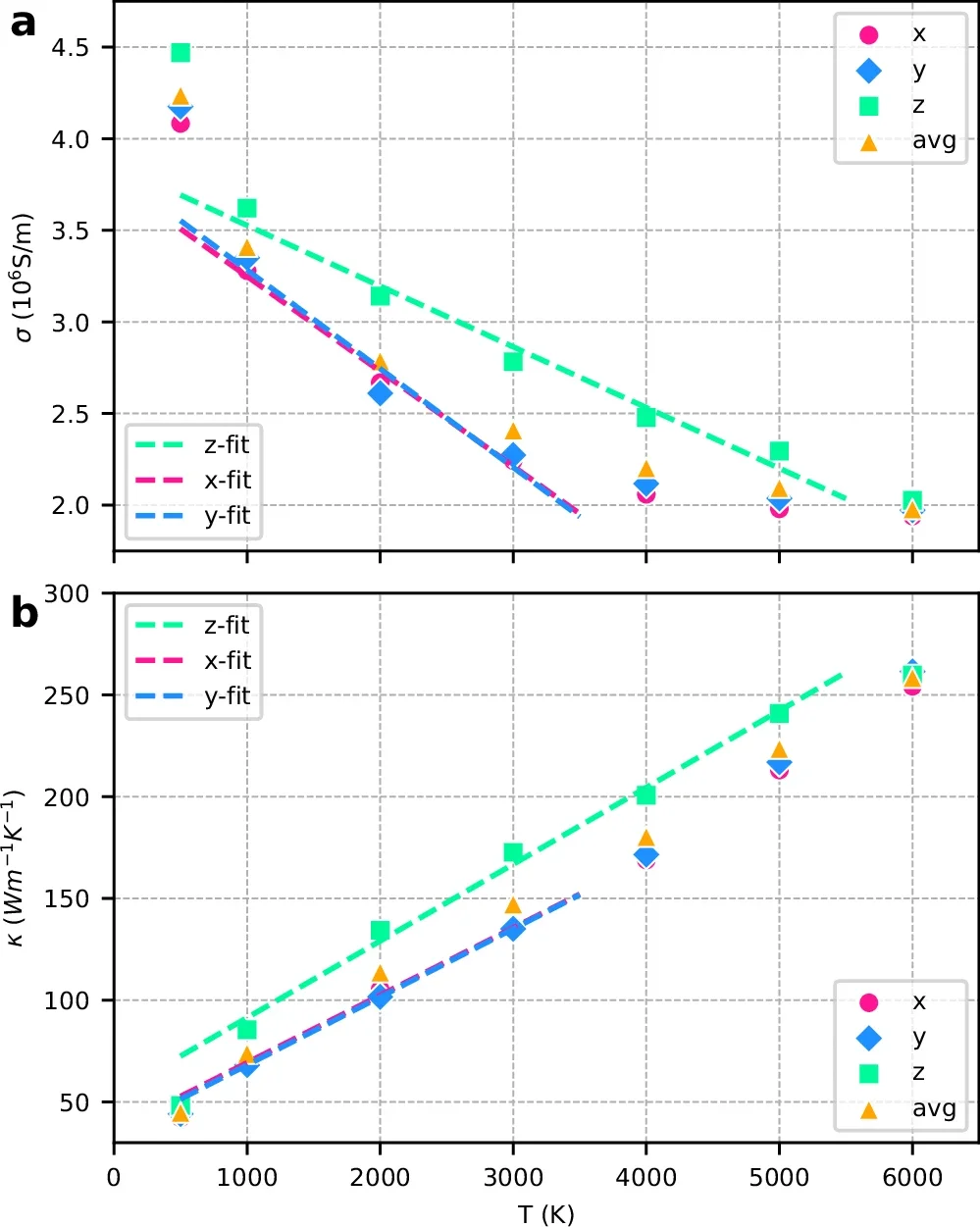
At lower temperatures, the material behaves like a solid. Carbon and hydrogen remain mostly fixed. As temperatures rise to about 2,000 Kelvin, hydrogen atoms begin moving along the helical axis while rotating around it in circles.
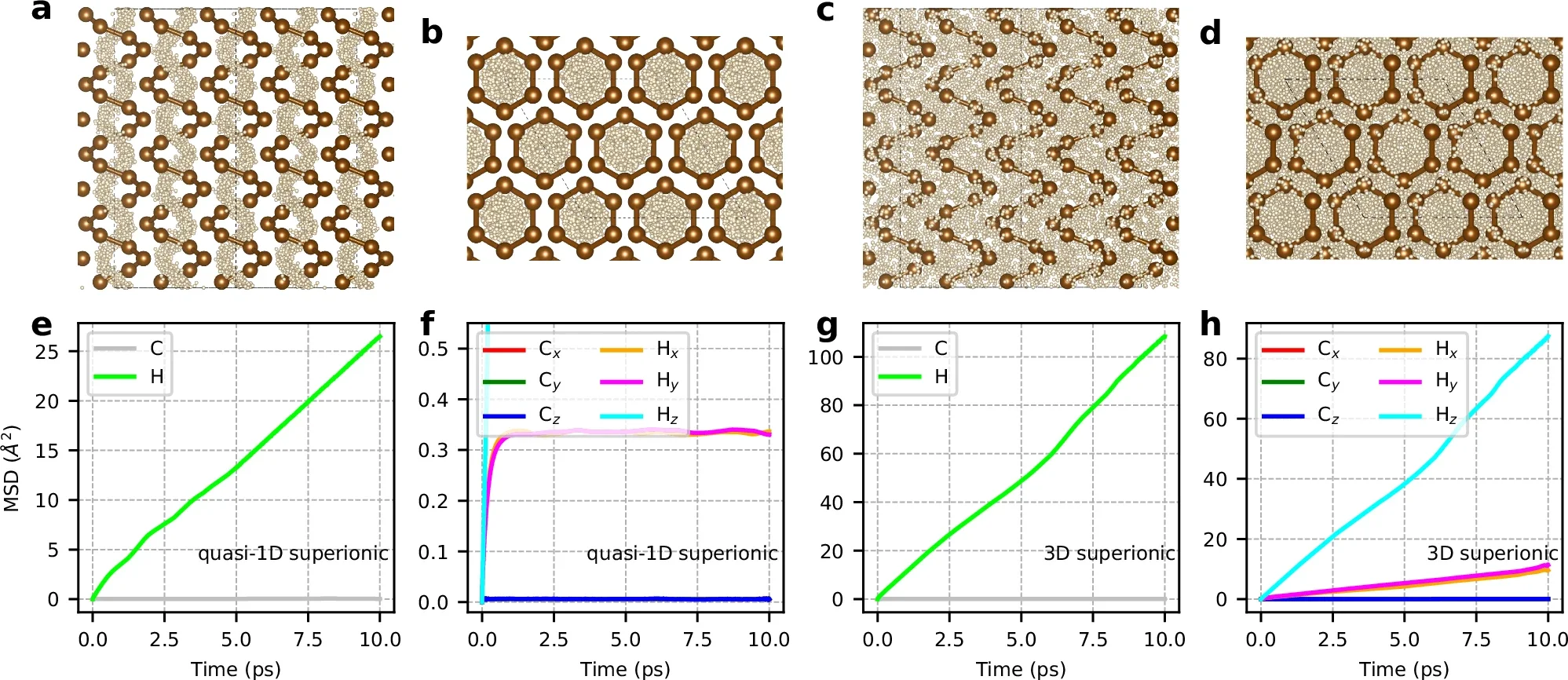
This creates what researchers call a quasi-one-dimensional superionic state.
The hydrogen atoms are mobile, but only in certain directions. That makes this phase highly anisotropic, meaning its properties change depending on direction.
Later, at even higher temperatures around 5,000 Kelvin, hydrogen begins diffusing freely in all directions. The material then transitions into a more conventional three-dimensional superionic state.
This unusual directional motion may have major consequences for giant planets.
Inside planets, heat and electricity move through dense materials. Those movements help shape magnetic fields and internal circulation. Most planetary models assume materials conduct energy similarly in every direction.
This new study suggests that assumption may not always hold true.
The quasi-one-dimensional state showed much higher electrical and thermal conductivity along the hydrogen spiral direction than across it. In simpler terms, energy moved more easily one way than another.
That could influence how heat escapes from planetary interiors. It may also affect how electrically conducting layers generate magnetic fields.
Uranus and Neptune already have unusual magnetic fields compared with Earth, Jupiter and Saturn. Their magnetic poles are tilted and oddly shaped. Scientists still struggle to explain why.
The new findings do not directly solve that mystery, but they provide a possible microscopic mechanism for directional transport deep inside planets.
“Such behavior could influence interior energy redistribution, electrical conductivity, and possibly the interpretation of magnetic-field generation in ice giants,” the researchers wrote.
The discovery highlights how artificial intelligence is changing planetary science.
The team used machine-learning-assisted structure searches to explore possible atomic arrangements under extreme conditions. Traditional calculations alone would have taken enormous computational time.
By combining machine learning with quantum mechanics, researchers simulated thousands of atomic interactions efficiently. They then confirmed the structures using advanced physics calculations.
The simulations also tested how the material behaved over time. Large-scale models containing up to 1,500 atoms showed that the quasi-one-dimensional state remained stable even with structural defects present.
This gave scientists greater confidence that the phase could truly exist under giant-planet conditions.
Although the study focused on carbon hydride, the findings may apply to many planetary materials.
Carbon and hydrogen are among the most common elements in the universe. They exist in stars, planets and interstellar clouds. Yet scientists still do not fully understand how these elements behave under extreme compression.
“Carbon and hydrogen are among the most abundant elements in planetary materials, yet their combined behavior at giant-planet conditions remains far from fully understood,” Liu said.
The pressures studied may exceed those found inside Uranus and Neptune. However, larger exoplanets called super-Earths or mini-Neptunes could easily reach these conditions.
The discovery may also matter for condensed matter physics and materials science. Researchers are increasingly interested in materials that conduct heat or electricity differently depending on direction.
The helical hydrogen pathways found in this study could inspire future work on advanced conductive materials or exotic quantum systems.
For decades, scientists classified matter into familiar categories like solid, liquid and gas. Research into planetary interiors continues to reveal that nature is far more creative.
Under immense pressure, atoms can form structures unlike anything found naturally on Earth’s surface. Simple ingredients can produce startling complexity.
The new carbon hydride phase expands the growing list of exotic matter states predicted inside giant planets. It also shows how much remains hidden beneath the clouds of distant worlds.
As computing power grows and observational tools improve, scientists expect more discoveries like this one. Missions studying giant planets, combined with laboratory experiments and simulations, may eventually reveal how these strange materials behave in reality.
For now, the study offers a powerful reminder that the universe still holds deep physical mysteries, even within familiar elements like carbon and hydrogen.
This research could improve how scientists model the interiors of giant planets and exoplanets. Better understanding of heat flow and electrical conductivity may help explain how planets generate magnetic fields and evolve over time. These insights could also improve interpretations of telescope observations from distant worlds.
The findings may eventually influence materials science as well. The newly predicted directional motion of hydrogen atoms could inspire future research into advanced conductive materials with unusual thermal or electrical properties. Scientists studying condensed matter physics may use these ideas to explore entirely new classes of engineered materials.
More broadly, the study demonstrates the growing power of machine learning and quantum simulations in scientific discovery. These tools allow researchers to investigate environments impossible to recreate fully in laboratories, helping humanity understand some of the universe’s most extreme conditions.
Research findings are available online in the journal Nature Communications.
The original story “Scientists discover new state of matter inside Uranus and Neptune” is published in The Brighter Side of News.
Like these kind of feel good stories? Get The Brighter Side of News’ newsletter.
The post Scientists discover new state of matter inside Uranus and Neptune appeared first on The Brighter Side of News.

