Plastic fragments smaller than a grain of rice are everywhere in modern wastewater, washed in from cosmetics, clothing, food packaging, and urban runoff. Treatment plants catch much of that material, but not all of it, and the smallest pieces can be the hardest to stop.
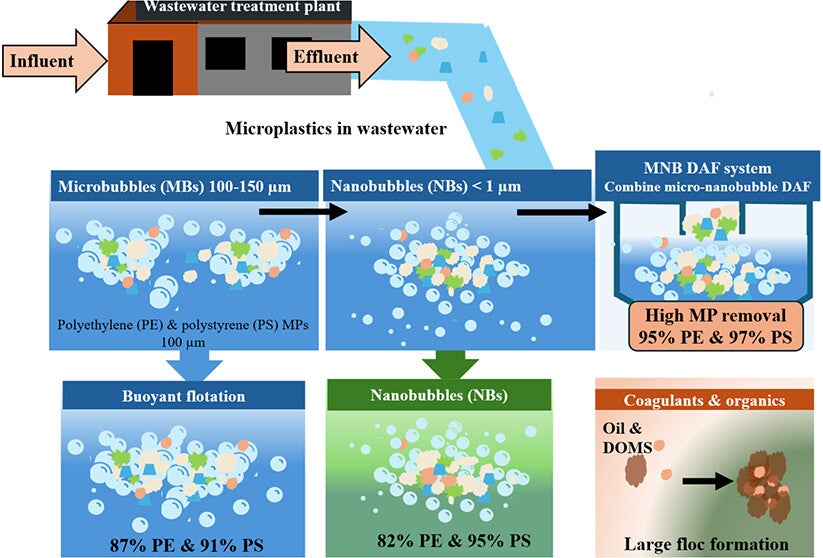
A team at RMIT University says one adjustment could make a sizable difference. By combining microbubbles and nanobubbles in a standard dissolved air flotation process, the researchers removed more than 90% of test microplastics from wastewater in laboratory experiments, with the best results reaching 95% for polyethylene and 97% for polystyrene.
The appeal is not just the removal rate. The researchers say the method could be adopted in existing wastewater treatment plants by adjusting operating conditions such as air pressure, saturation time, and bubble size, rather than rebuilding systems from scratch.
“Wastewater treatment plants are a major pathway for microplastics as they slip through filtration processes, posing risks to ecosystems and human health,” said Associate Professor Biplob Pramanik, lead author of the study and director of RMIT’s Water Effective Technology and Tools Research Centre.
“Our approach is simple to implement and significantly increases the removal of microplastics during the primary stage of treatment.”
The work centers on dissolved air flotation, or DAF, a common treatment method that removes contaminants by attaching them to air bubbles and carrying them to the surface, where they can be skimmed away. It is already used to separate low-density material that does not settle easily.
What changes here is the bubble mix.
Microbubbles provide the lift. They help carry particles upward once the particles have attached. Nanobubbles, far smaller and much slower to rise, improve how often particles collide, stick together, and remain attached long enough to be removed. Used together, the two bubble types outperformed systems that relied on either one alone.
The study focused on 100-micrometer particles of polyethylene and polystyrene, both common plastics in wastewater. That size was chosen because it reflects the frequent size of microplastics found in treatment systems.
In the experiments, the best-performing microbubbles measured about 105 micrometers across, while the most effective nanobubbles averaged about 820 nanometers. Under those conditions, microbubble-only treatment removed up to 87% of polyethylene and 91% of polystyrene. Nanobubbles alone performed better, reaching 92% and 95%, respectively. The combined system pushed removal higher still.
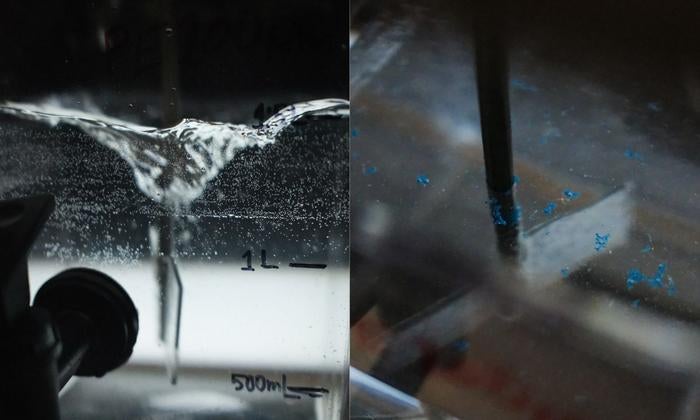
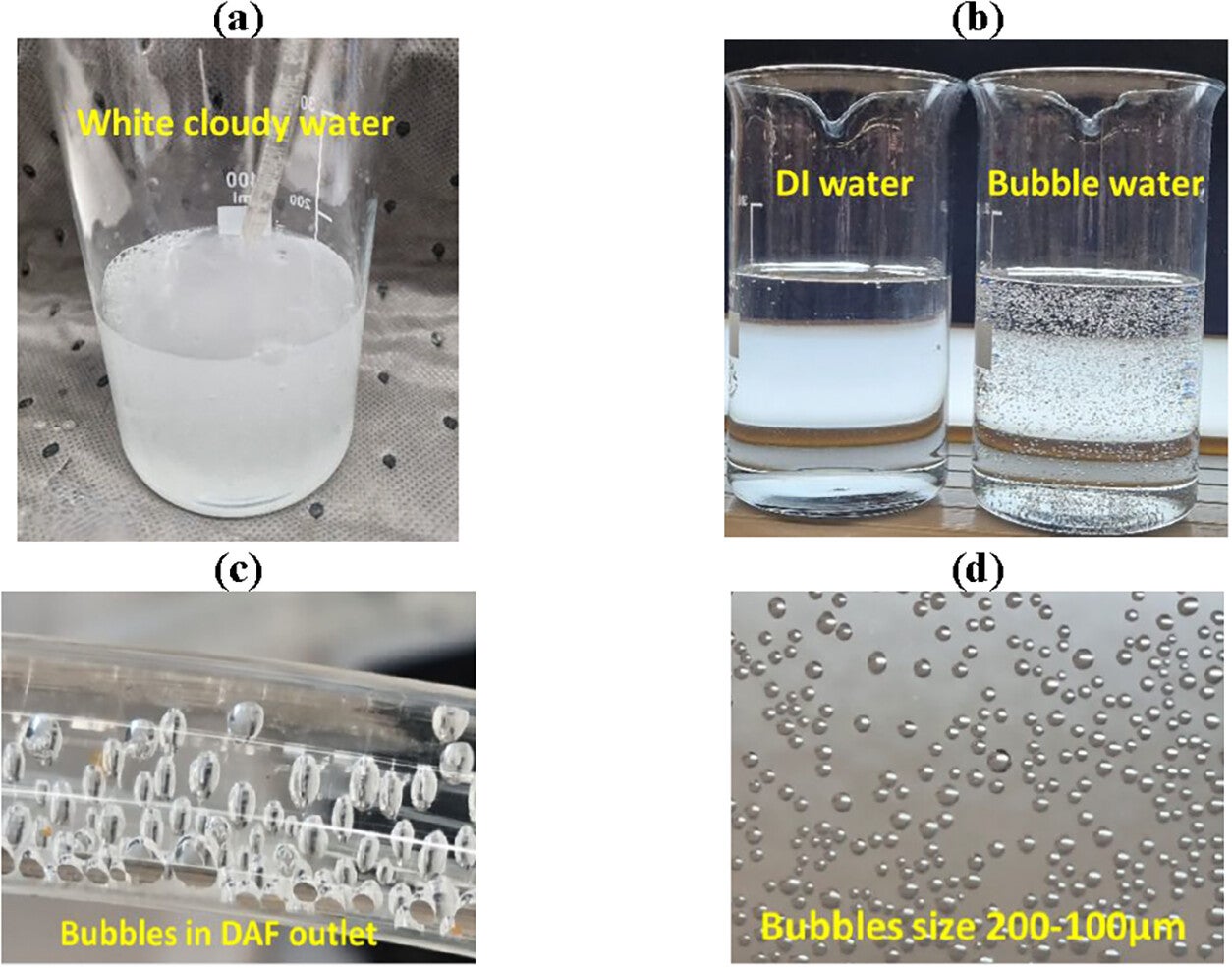
Bubble size turned out to be central to the process. At a fixed pressure of 5 bar, longer saturation times produced smaller bubbles. Microbubbles ranged from 5 to 203 micrometers, while nanobubbles shrank from about 2 micrometers down to 395 nanometers as saturation time increased.
Higher pressure also drove bubble size down. With a 5-minute saturation time, average microbubble size dropped from about 200 micrometers at 2 bar to 90 micrometers at 6 bar. For nanobubbles generated with a 25-minute saturation time, size fell from about 850 nanometers to 450 nanometers across the same pressure range.
That matters because smaller bubbles offer more surface area relative to their volume and spend longer in contact with suspended particles. In flotation, those extra moments can improve collision, adhesion, and the odds that a plastic particle gets carried away instead of passing through.
The team also measured the bubbles’ zeta potential, a marker of surface charge that affects stability. Both microbubbles and nanobubbles stayed negatively charged across a pH range of 3 to 9, with nanobubbles showing more strongly negative values. That pattern suggests the bubbles remained stable in water and were less likely to merge with one another too quickly.
One of the more practical findings came when the researchers tested the system in synthetic wastewater containing dissolved organic matter and fats, oils, and grease, conditions meant to resemble the messier chemistry of real wastewater.
Those materials are often treated as obstacles because they can coat particles, interfere with floc formation, or compete for coagulants. But in this study, they did not weaken performance. In some cases, they appeared to help.
With dissolved organic matter alone, the combined bubble system removed 91% of polyethylene and 94% of polystyrene. When fats, oils, and grease were added as well, removal rose to 95% and 97%.
Dr. Sirajum Monira, who completed the research during her PhD at RMIT, said the results held up under conditions that more closely reflected what treatment plants face every day.
“Organic matter and fats, oils and grease, which are typically considered barriers to treatment, did not reduce performance,” she said.
“In some cases, they improved it by helping microplastics clump into larger, more easily removed particles when combined with standard coagulants.
“By capturing the microplastics before they become concentrated in sewage sludge, we can reduce the amount entering biosolids and ultimately minimise their release back into the environment.”
The study found that polystyrene was consistently removed more efficiently than polyethylene. The researchers linked that difference to surface texture.
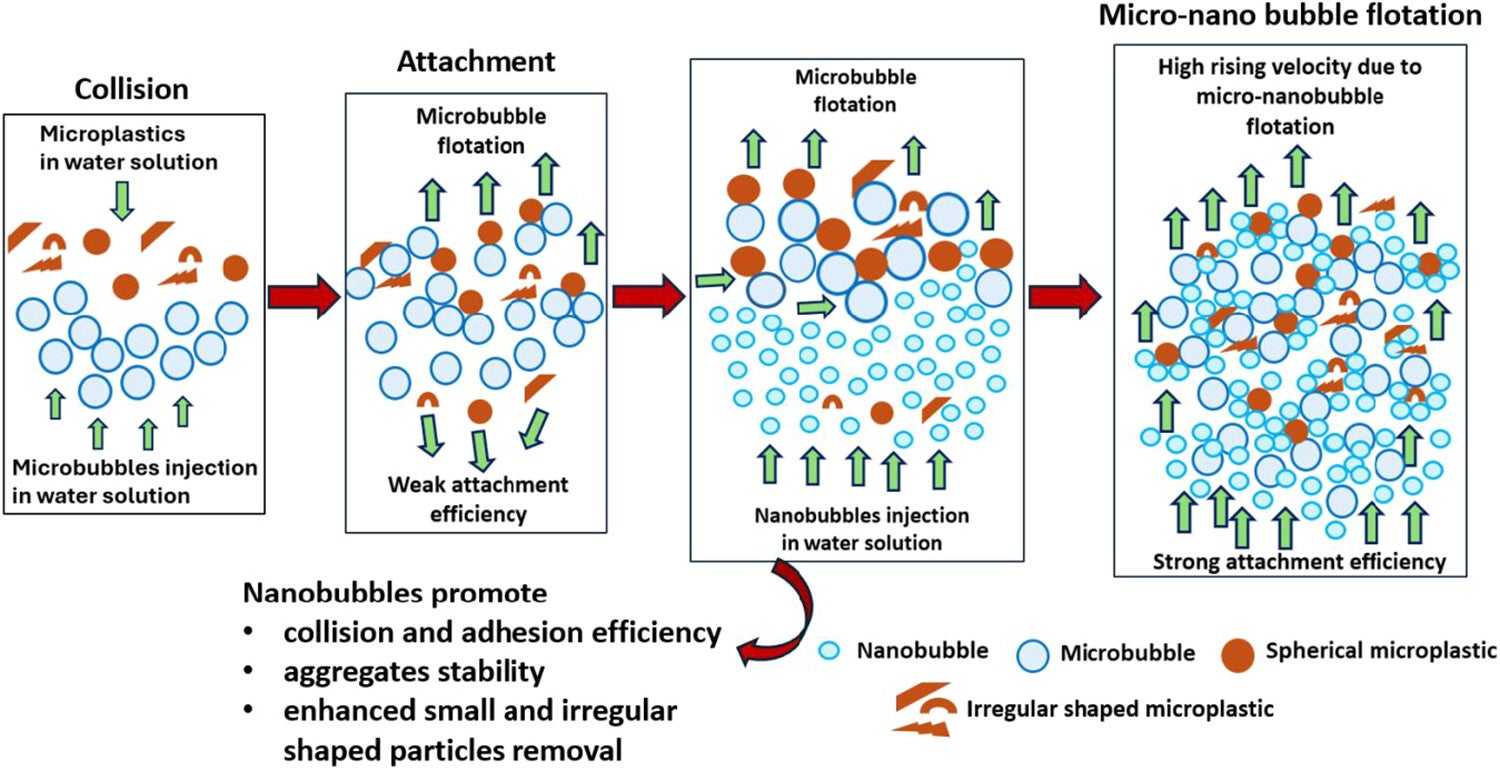
The polystyrene particles used in the tests had rougher surfaces, which likely gave bubbles more points to latch onto. Polyethylene particles were smoother, offering fewer anchoring points and slightly lower flotation efficiency. That finding suggests the physical shape and texture of microplastics may influence how well treatment systems capture them.
The broader concern is what happens when these particles are not removed. Microplastics smaller than 5 millimeters are now recognized as emerging contaminants in aquatic environments, and many continue breaking down into even smaller nanoplastics. Because of their size and large surface area, they can carry heavy metals and organic pollutants and move them through ecosystems.
Municipal treatment plants are a major collection point for this material, but also a pathway. Fibers shed from synthetic clothing, particles from personal care products, and fragments of degraded plastic all enter wastewater streams. Conventional systems remove a substantial share, but a meaningful fraction can remain in treated effluent or sewage sludge.
The RMIT team says that is why earlier interception matters. Stopping more of the material during primary treatment could reduce what moves into downstream processes, into biosolids, and eventually into the wider environment.
The findings suggest wastewater plants may be able to improve microplastic capture without major new infrastructure. By tuning air pressure, saturation time, and bubble size distribution in dissolved air flotation systems, operators could strengthen removal during the earliest treatment stage.
The results also point to a useful operational advantage: realistic wastewater ingredients such as dissolved organic matter and fats, oils, and grease did not shut the process down. That makes the approach more relevant to real plant conditions than a cleaner laboratory system alone would.
The research was carried out at laboratory scale, so the next step is clear. The team wants to work with industry partners to test the method under full operating conditions and across different wastewater streams. If those trials hold up, a simple shift in how bubbles are made could become a practical tool for cutting plastic pollution before it leaves the plant.
Research findings are available online in the journal ACS ES&T Water.
The original story “Scientists use microbubbles and nanobubbles to remove 90% of microplastics from water” is published in The Brighter Side of News.
Like these kind of feel good stories? Get The Brighter Side of News’ newsletter.
The post Scientists use microbubbles and nanobubbles to remove 90% of microplastics from water appeared first on The Brighter Side of News.


Leave a comment
You must be logged in to post a comment.