For generations, the search for life beyond Earth has focused on avoiding one of science’s biggest mistakes: claiming a discovery that turns out not to be real. Researchers have built entire frameworks around preventing these so-called false positives, cases where evidence appears to point to extraterrestrial life but ultimately has a non-biological explanation.
A new study argues that another risk may be just as important, yet receives far less attention. What if signs of alien life already exist, but scientists fail to recognize them?
Researchers led by Professor Inge Loes ten Kate of Utrecht University and the University of Amsterdam warn that the search for life across the universe may be vulnerable to false negatives, situations in which life is present, or once existed, but goes undetected. According to the authors, overlooking these possibilities could influence scientific priorities, shape future space missions, and even affect decisions about how humanity explores and uses other worlds.
The study suggests that as governments and space agencies invest billions of dollars in ambitious missions, researchers need to spend more time asking not only how to find life, but also how they might accidentally miss it.
Astrobiology, the scientific field devoted to understanding the origins and existence of life in the universe, has entered one of its most active periods.
Robotic explorers continue to investigate Mars. Space telescopes examine the atmospheres of distant planets orbiting other stars. Future missions aim to study icy moons, including places that may conceal oceans beneath frozen surfaces.
Despite these advances, scientists rarely expect to find living organisms directly. Instead, they search for biosignatures, measurable clues that may indicate biological activity.
These clues can take many forms. They may include atmospheric gases, unusual minerals, organic molecules, or chemical patterns that living organisms create.
Interpreting such evidence is rarely straightforward. Natural geological or chemical processes can often produce signals that resemble those created by life.
Because of this challenge, researchers have spent decades developing methods to avoid false positives. The authors of the new study argue that this emphasis has created an unintended blind spot.
“We should be aware of these false-negative results,” said Inge Loes ten Kate. “It means there are shortcomings in recognising the existence of life. These shortcomings are not yet high on the research agenda.”

A false negative occurs when life exists but remains undetected.
This can happen for many reasons. Traces of life may not survive long enough to be found. Instruments may lack the sensitivity needed to detect weak signals. Scientists may search in the wrong place or focus on the wrong indicators.
According to the researchers, the consequences can be significant.
If scientists repeatedly fail to detect evidence of life in a particular environment, they may conclude that the location is unpromising. Future missions could then shift attention elsewhere.
Researchers also warn that policymakers could make decisions based on incomplete information.
“If there is life under a rock, and you only look at that rock from above, that life will go unnoticed,” said ten Kate. “So, investigate thoroughly whether the conditions for the existence of life forms are present in the environment, and whether you can recognise patterns on the surface of a celestial body.”
The concern extends beyond scientific curiosity. If life remains hidden on another world, future resource extraction or industrial activities could unknowingly damage or destroy ecosystems before they are ever discovered.
One of the most famous examples of a potential false negative comes from Mars.
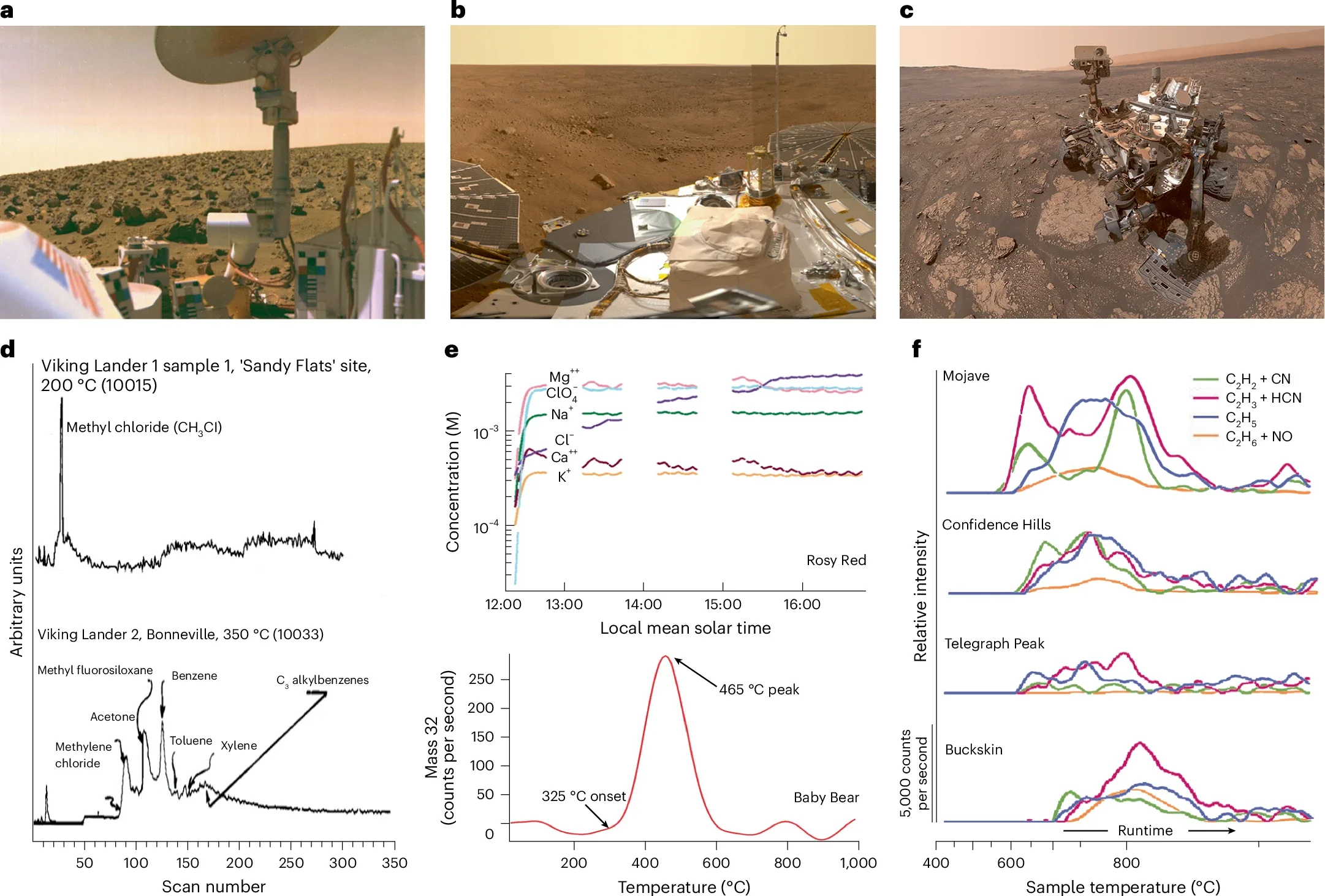
In 1976, NASA’s Viking landers became the first spacecraft specifically designed to search for signs of life on the Martian surface. The results puzzled scientists.
One experiment detected compounds that researchers interpreted as contamination from Earth rather than evidence of Martian organic material. At the same time, another experiment produced results consistent with possible biological activity.
Because the findings appeared contradictory, most scientists concluded that Viking had not found convincing evidence of life.
Years later, discoveries complicated that interpretation.
Scientists learned that perchlorate salts in Martian soil could alter organic molecules during testing. Those reactions may have changed the results Viking observed.
Subsequent missions, including NASA’s Curiosity rover, later confirmed that organic compounds do exist on Mars.
This does not prove that Viking discovered life. However, it demonstrates how difficult interpretation can be and how an apparently negative result may not always tell the whole story.
The study argues that similar situations could occur elsewhere if scientists do not carefully consider the possibility of false negatives.
One reason false negatives occur is that scientists naturally search for life as they know it.
Researchers often assume that life will be widespread, active, and obvious enough to generate detectable signals. Yet Earth repeatedly demonstrates that life can survive under surprisingly difficult conditions.
Microorganisms thrive beneath rocks, deep underground, and in environments once considered uninhabitable. Some survive in tiny populations that produce only faint traces of their existence.
Life can also remain dormant for long periods. An ecosystem might be biologically active overall while showing little outward evidence at the moment scientists observe it.
The study notes that assumptions about appearance can be equally misleading.
Tiny organisms known as picoeukaryotes challenged previous ideas about how small complex life could be. Similar surprises could await researchers searching other worlds.
“But how do you investigate things you can’t find?” ten Kate asked. “That question goes to the heart of our problem, because we tend to look for things we already know.”
Even when life produces detectable signatures, environmental processes can hide them.
On planets with atmospheres, gases created by living organisms may never accumulate to easily detectable levels. Chemical reactions can remove them before instruments observe them.
Other signals may overlap with non-biological processes, making interpretation difficult.
The authors point out that atmospheric chemistry, geological activity, cloud cover, dust, and radiation can all disguise evidence of life.
Some biosignatures may survive only briefly. Others may become altered over time until they look entirely different from their original forms.
A recent example illustrates this challenge. Scientists discovered unusual iron-bearing minerals on Mars that display oxidation patterns unlike nearby minerals.
On Earth, similar patterns are often associated with biological activity.
Ten Kate emphasizes that these minerals do not represent evidence of a false negative. Instead, they demonstrate how much remains unknown.
“On Earth, we only see such differing oxidation as a result of the presence of life. But does that necessarily mean that we are dealing with life in an extraterrestrial context?” she said.
Without further investigation, scientists cannot know whether such observations point toward biology or some unfamiliar geochemical process.
The researchers argue that future missions should place greater emphasis on understanding how false negatives arise.
Current life-detection instruments are typically designed to identify specific signs of biology. Yet mission planners rarely evaluate how likely those tools are to miss existing evidence.
The authors recommend combining laboratory experiments, computer modeling, and field studies to better understand where and why detection failures occur.
They also encourage the development of more focused scientific questions before missions launch.
“The search for signs of life should go hand in hand with better-defined questions and testable hypotheses to justify specific measurement or observation targets,” said ten Kate.
Artificial intelligence could also help.
“Because then you might well uncover things that we would never be able to see on our own,” she said. “And with new observations, you can then work out how and where they fit into such a pattern.”
The researchers believe the greatest challenge may be conceptual rather than technological.
If extraterrestrial life differs significantly from life on Earth, existing search strategies may fail entirely. Scientists could encounter evidence without recognizing its significance.
As new missions prepare to explore Mars, icy moons, and distant exoplanets, the study calls for a shift in perspective.
Finding life requires more than building better instruments. It also requires questioning assumptions about where life exists, what it looks like, and how it leaves traces behind.
The universe may not be silent. Humanity’s challenge may be learning how to listen more carefully.
This research could significantly influence how future space missions are designed and how scientists interpret evidence from other worlds. By focusing more attention on false negatives, researchers may develop broader detection strategies that reduce the risk of overlooking biological activity. Future instruments could be designed not only to identify known biosignatures but also to recognize unusual patterns that do not fit existing expectations.
The findings may also shape policy decisions related to planetary exploration and resource use. If life can remain hidden despite advanced technology, scientists and policymakers may need to exercise greater caution before exploiting extraterrestrial environments. Better understanding of false negatives could help protect potentially inhabited worlds from accidental contamination or destruction.
For astrobiology, the study encourages a more balanced approach that considers both false positives and false negatives. This shift could improve the chances of discovering life beyond Earth and deepen our understanding of how life emerges, survives, and evolves throughout the universe.
Research findings are available online in the journal Nature Astronomy.
The original story “Scientists warn we may be missing signs of alien life across the universe” is published in The Brighter Side of News.
Like these kind of feel good stories? Get The Brighter Side of News’ newsletter.
The post Scientists warn we may be missing signs of alien life across the universe appeared first on The Brighter Side of News.


Leave a comment
You must be logged in to post a comment.