Entanglement sits at the heart of quantum technology, but it is rarely easy to make. The most powerful states often demand delicate hardware, custom-built controls, and a long list of moving parts. That is why a new proposal from the University of Chicago is drawing attention. It suggests that a much simpler setup may be able to produce a surprisingly wide range of complex quantum states. This includes some that could improve sensors and help physicists study exotic forms of matter.
The work, published in Physical Review X, lays out a theoretical method for generating and controlling entangled states in cavity quantum electrodynamics, or cavity QED, a platform already familiar in many quantum labs. The idea begins with atoms placed inside an optical cavity. There, light bounces between two mirrors and interacts with the atoms.
In standard cavity QED, all the atoms usually couple to the light in the same way. That sameness is useful, but it also imposes limits.
“We wanted to take simple ingredients that you find in a lot of physical platforms and put these together in a minimal way to get something interesting, complex and powerful,” said Aashish Clerk, professor of molecular engineering at the University of Chicago Pritzker School of Molecular Engineering and senior author of the study.
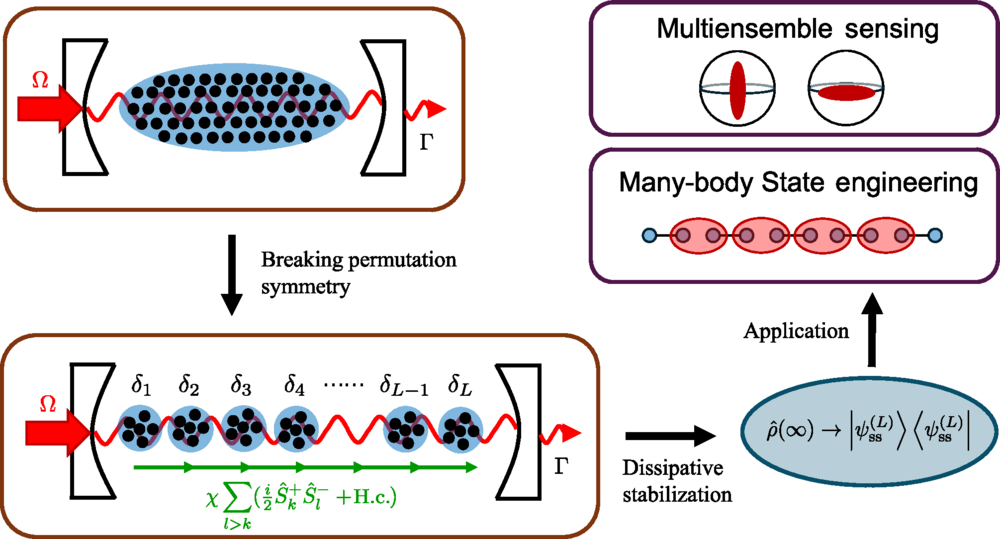
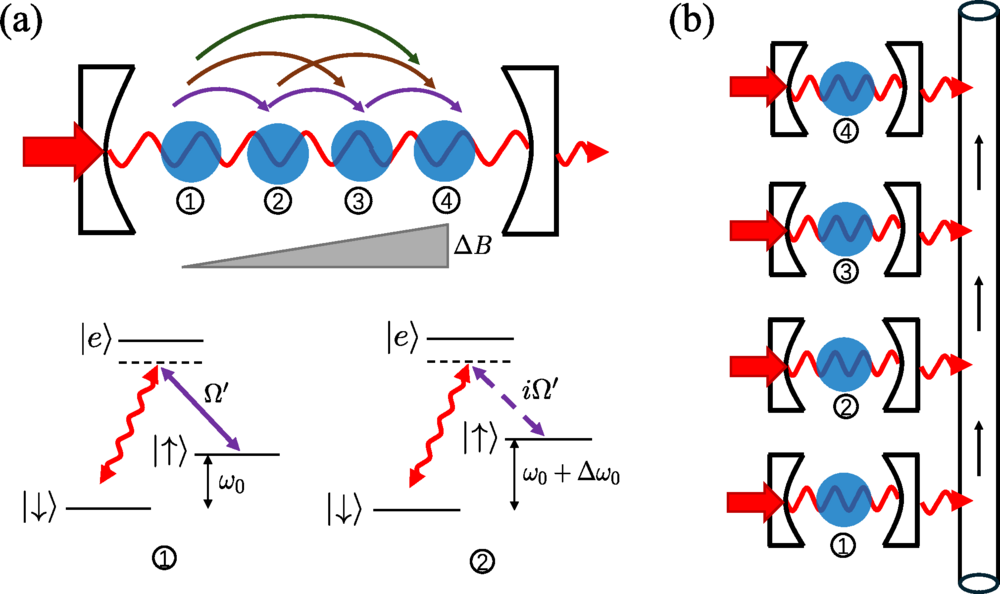
The core trick is to make groups of atoms slightly different from one another without changing the physical apparatus. In the proposal, all atoms are still driven by a common laser. But additional lasers or a magnetic field shift the excited-state energy of selected groups. The offsets are assigned in equal-and-opposite pairs, which breaks the usual symmetry. Nevertheless, the system remains organized enough to solve and control.
That change matters because ordinary collective cavity systems tend to funnel the dynamics into a narrow family of states. Once the symmetry is relaxed, the menu expands.
“The challenge has always been that these systems have too much symmetry. All the atoms are talking to light in the same way,” Clerk said. “That really restricts what kind of entangled states you get.”
The new scheme keeps the dissipative part of the system simple. It still relies on a single collective loss process, the sort commonly found in cavity QED experiments, rather than a large set of finely engineered dissipative channels. By varying the pattern of laser detunings, the team showed that the same platform can settle into many different pure entangled steady states.
“You turn these lasers on and wait, and at some point the system stabilizes into an interesting, highly entangled quantum state,” said Anjun Chu, a postdoctoral researcher in the Clerk group and first author of the work. “By simply adjusting the lasers, we can access kinds of entangled states that no one had thought about before.”
That reconfigurability is one of the paper’s main claims. Instead of building a new device for each target state, researchers could tune the same system into different regimes by changing control settings.
One immediate application is quantum sensing. Entangled states can, in principle, detect tiny differences between magnetic or gravitational fields at separate locations. In practice, the states that offer the best sensitivity are often fragile, hard to read out, or both.
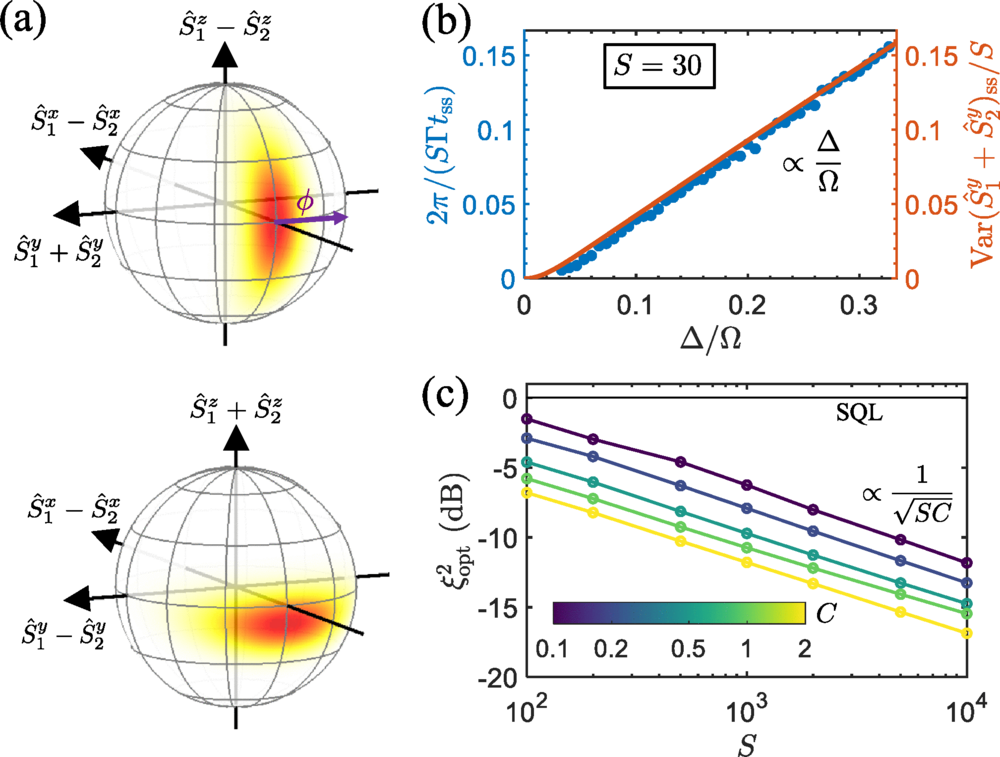
The Chicago team focused first on a setup with two atomic ensembles. In their analysis, the resulting state can be used to measure a field gradient, meaning the difference in field between two places. At the same time, it filters out common background noise that affects both ensembles equally. The authors argue that the state can reach Heisenberg-limited scaling, the benchmark for the strongest quantum enhancement. Yet it is still compatible with simple Ramsey measurements rather than exotic multibody readouts.
That combination is unusual.
“You’re able to do two things that are normally not compatible with one another: Use entanglement to build an exquisitely sensitive sensor but also have robustness to arbitrarily large amounts of noise,” Clerk said. “Normally, entanglement is very fragile. This approach has some amazing resilience.”
The paper argues that this resilience extends even when common-phase noise becomes large. The state remains useful because the information about the differential signal survives those shared fluctuations. The team also showed that the same general strategy can be extended from two ensembles to four. This allows sensitivity not just to a gradient but to the curvature of a spatially varying field.
In that four-ensemble case, the entanglement structure becomes richer. Depending on how the detunings are arranged, the system can distribute metrological advantage across different collective modes. The authors found that this can preserve strong sensitivity even in the presence of both common-phase noise and gradient noise.
The proposal reaches beyond sensing. By arranging many ensembles in a one-dimensional chain and using chiral spin-exchange interactions, the researchers showed that the same framework can stabilize families of entangled states with broader many-body significance.
One standout example is the AKLT state, a landmark state introduced in the 1980s in the study of exotic magnetic materials. The AKLT state has since become important in discussions of symmetry-protected topological order and measurement-based quantum computing. In the new work, the team showed that their cavity-based setup can produce the spin-1 AKLT state in a particular limit.
That is a notable result because many theoretical state-preparation schemes demand much more elaborate control. Here, the authors say the AKLT state emerges from the same general ingredients used elsewhere in the paper. These are one collective decay channel, structured detunings, and a tunable interaction pattern.
The method also generates a broader family of matrix product states with string order, a hallmark of hidden order in one-dimensional quantum systems. For half-integer spins, the authors found that these states can exhibit symmetry-protected topological features in the large-drive limit. In plain terms, the platform is not only a sensor factory. It could also become a way to engineer and study quantum phases that are hard to access in ordinary materials.
For now, the work remains theoretical. The researchers say they are discussing possible implementations with experimental groups and are continuing to explore more complicated atomic arrangements and the range of states the method can access.
Its appeal lies partly in restraint. The proposal does not promise a universal quantum computer, and it does not depend on one either. Instead, it points to a middle ground in quantum science. In this regime, useful and highly structured states might be produced before the field reaches its most ambitious long-term goals.
“The fact that such simple ingredients can generate such complex and useful quantum states gives us hope that even before we reach the dream of a general all-purpose quantum computer, we can already generate quantum states that let us do things we couldn’t do in a purely classical world,” Clerk said.
This work suggests that existing cavity QED platforms may be able to do more with less. If experiments confirm the theory, labs could use familiar equipment and common laser controls. They could also use a single collective loss process to prepare entangled states that were previously associated with much more complicated designs.
That could make quantum-enhanced sensing more practical, especially for measuring tiny field differences while rejecting shared noise.
It could also give physicists a flexible new way to create and test many-body states, including topological states such as the AKLT state, without needing a fully general quantum computer.
Research findings are available online in the journal Physical Review X.
The original story “University of Chicago team proposes flexible new platform to produce entangled quantum states” is published in The Brighter Side of News.
Like these kind of feel good stories? Get The Brighter Side of News’ newsletter.
The post University of Chicago team proposes flexible new platform to produce entangled quantum states appeared first on The Brighter Side of News.


Leave a comment
You must be logged in to post a comment.