Eighty years after ENIAC helped launch the electronic age at the University of Pennsylvania, a new Penn-led advance points to a very different way of computing.
Instead of relying on electrons, which lose energy as heat and become harder to manage as chips grow more complex, physicists are pushing light deeper into the job. Their latest work centers on a hybrid particle. This particle lets light do something it usually struggles with in computing: interact strongly enough to switch signals on and off.
That hybrid, called an exciton-polariton, blends the speed of photons with the stronger interactions of matter. In the new research, Penn physicists built a system that uses these quasiparticles to perform all-optical switching with about 4 femtojoules of energy, or roughly 4 quadrillionths of a joule. Furthermore, the team says that figure sets a new benchmark for switching energy in two-dimensional exciton-polariton systems.
The work, published in Physical Review Letters, could matter most in artificial intelligence, where hardware now spends huge amounts of energy moving data, processing it, and shedding heat.
“Because they are charge-neutral and have zero rest mass, photons can carry information quickly over long distances with minimal loss, dominating communications technology,” Li He, co-first author of the study and a former postdoctoral researcher in the lab of Penn physicist Bo Zhen, said in a statement to The Brighter Side of News. “But that neutrality means they barely interact with their environment, making them bad at the sort of signal-switching logic that computers depend on.”
Photonic AI chips already handle some straightforward calculations using light. The trouble comes when they reach nonlinear activation steps, the decision-making operations that many computing tasks depend on. At that point, many systems still have to convert optical signals back into electronic ones. Those repeated handoffs slow things down and eat into the efficiency that made photonic computing attractive in the first place.
Zhen’s team tried to solve that problem by pairing photons with excitons, which are bound states involving electrons inside a semiconductor. The result is an exciton-polariton. This is a quasiparticle that keeps some of light’s speed while gaining stronger interactions from matter.
That combination is not new in principle. Exciton-polaritons have long attracted attention because they can produce unusual effects such as polariton lasing, Bose-Einstein condensation, and superfluidity. They are also valued for their strong nonlinear response, a property that could make them useful for all-optical computing and photonic quantum information processing.
But older platforms have come with stubborn trade-offs.
Systems based on III-V quantum wells can show nonlinear effects at extremely low light levels, even down to the single-photon scale, yet they are limited to cryogenic temperatures and can degrade during nanofabrication. Organic semiconductor systems avoid some of those issues. However, they often bring problems with stability and compatibility in device processing. Together, those limitations have made it hard to build dense, scalable polaritonic circuits.
The Penn team turned instead to atomically thin transition metal dichalcogenides, or TMDs, which have emerged as a promising route for nonlinear exciton-polaritons. These materials offer sharp exciton resonances and can be integrated with photonic structures. The challenge is squeezing light tightly enough to strengthen the interactions while keeping losses low and preserving control over the material’s charge state.
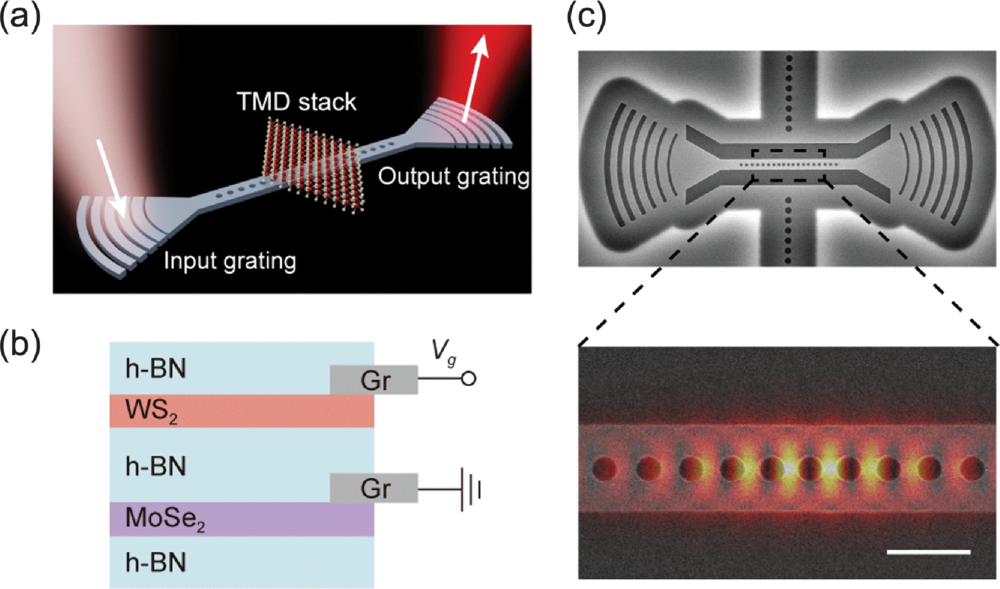
To do that, the researchers integrated a gate-tunable monolayer of molybdenum diselenide, or MoSe2, with a silicon nitride photonic crystal nanocavity. The device also included a WS2 monolayer, separated from the MoSe2 by a roughly 10-nanometer-thick layer of hexagonal boron nitride, forming a parallel-plate capacitor. Additionally, the WS2 layer served as a transparent top gate, minimizing optical absorption near the MoSe2 exciton energy.
The nanocavity itself had an ultracompact mode volume of about 0.05 cubic micrometers, several orders of magnitude smaller than conventional distributed Bragg reflector cavities. That matters because tighter confinement boosts the interaction between light and excitons and strengthens the polariton nonlinearity.
The cavity was fabricated on a silicon nitride-on-insulator wafer with a 145-nanometer-thick silicon nitride layer. The structure was suspended from the silicon dioxide substrate to improve optical confinement, and light was sent in and out through grating couplers at each end.
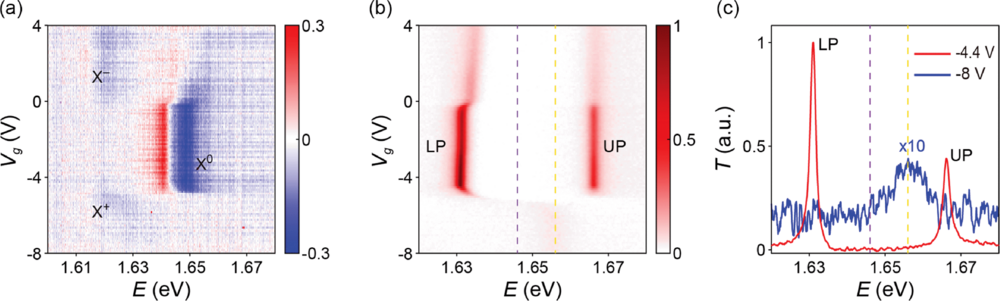
At 4 kelvin, the team measured the optical behavior of the coupled device. In the charge-neutral regime, the MoSe2 monolayer showed a strong neutral exciton resonance at 1.646 electron volts, with a linewidth of 5.4 millielectron volts. When the gate voltage shifted the material into n-doped or p-doped states, that neutral exciton weakened and trion resonances appeared at 1.616 electron volts.
The team also found a strong-coupling regime in which the device produced two polariton peaks, an upper polariton at 1.666 electron volts and a lower polariton at 1.631 electron volts. Their measured linewidths were 2.3 and 1.8 millielectron volts, respectively. From those data, the researchers extracted an exciton-photon coupling strength of 16.8 millielectron volts.
The central result came when the team tested how the system behaved under pulsed laser excitation.
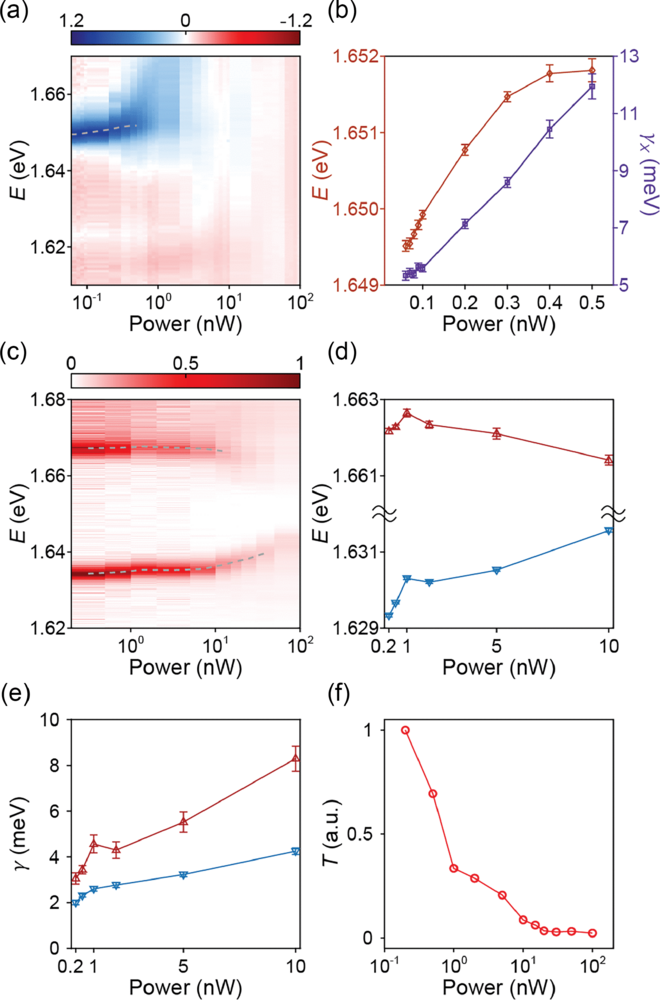
As the optical power increased, the lower and upper polariton modes shifted in energy and broadened. The lower polariton blueshifted by 1 millielectron volt as excitation rose from 0.2 to 1 nanowatt. The upper polariton shifted by 0.5 millielectron volts over that range, then turned and redshifted at higher powers. Both modes broadened across the power range, which damped the resonances and reduced optical transmission.
That nonlinear response allowed the device to act as an all-optical switch. At the lower polariton resonance, normalized cavity transmission dropped by 50% at excitation power below 1 nanowatt. After accounting for the mismatch between the laser’s spectral width and the much narrower polariton linewidths, along with grating coupler efficiency, the team calculated a switching energy of just 4 femtojoules.
That is a steep drop from the picojoule-range thresholds reported for state-of-the-art two-dimensional exciton-polariton systems, according to the researchers.
The switching was also fast.
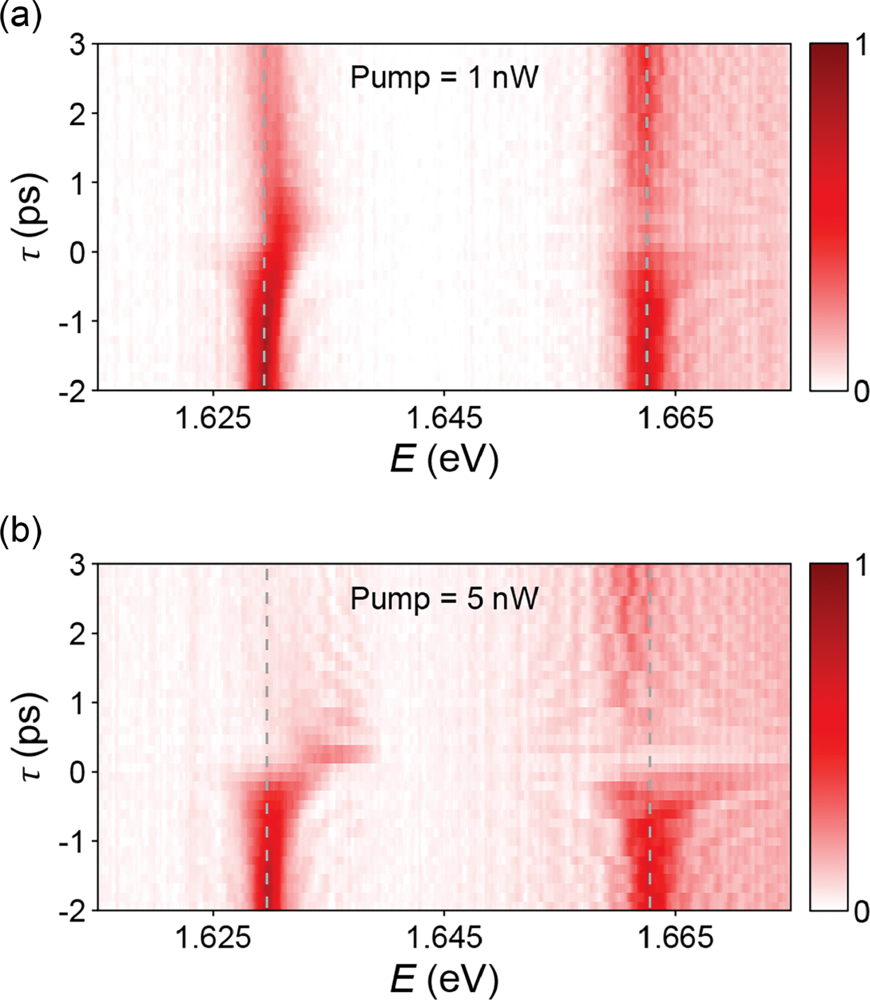
Using pump-probe spectroscopy, the group found that under a 1-nanowatt pump, the lower polariton reached a maximum blueshift of 1.3 millielectron volts about 133 femtoseconds after excitation, then relaxed back within roughly 3 picoseconds. At 5 nanowatts, cavity transmission was quenched within about 200 femtoseconds. However, some slower recovery effects stretched into the hundreds of picoseconds, likely because of impurity-trapped exciton states with relatively long lifetimes.
That slower tail is one of the study’s clear limitations. The authors say more work is needed to pin down the source of those long-lived excitations and find ways to reduce them, possibly by using higher-quality bulk crystals with fewer defects.
The immediate appeal is more efficient photonic computing, especially for AI hardware that now pays a large energy penalty whenever it has to move between optical and electronic signals.
If this kind of platform can be scaled, it could help chips process light directly from cameras, cut the power demands of large AI systems, and handle nonlinear operations without leaving the optical domain. That would preserve more of the speed and efficiency that photonic hardware promises in theory.
The longer-term possibilities reach further. The researchers say the current 4-femtojoule switching energy could be reduced by two to three orders of magnitude through better materials and improved photonic design. They point to trions or moiré excitons as possible routes to stronger nonlinear responses, and to higher-index, low-loss photonic platforms for tighter confinement and longer polariton lifetimes.
Those changes, they argue, could push the system toward few-polariton or even single-polariton nonlinearities. At that point, the same platform could begin to support basic quantum photonic information processing as well as classical optical computing.
Research findings are available online in the journal Physical Review Letters.
The original story “UPenn physicists make ‘light’ work of computing” is published in The Brighter Side of News.
Like these kind of feel good stories? Get The Brighter Side of News’ newsletter.
The post UPenn physicists make ‘light’ work of computing appeared first on The Brighter Side of News.

