Thirty million years separate the freezing of Antarctica from the glaciation of the Arctic, and for decades that gap made little sense. If falling carbon dioxide levels drove the planet into an ice age, both poles should have felt it around the same time. Instead, a vast ice sheet smothered the southern continent while the north remained largely open water and bare land.
The answer, according to a new international study published in Science, was never primarily about the atmosphere. It was about the ground beneath Antarctica itself.
A team led by researchers at the University of Southampton found that slow-moving waves of energy deep within Earth’s mantle gradually pushed large sections of East Antarctica skyward over roughly 100 million years, building the elevated terrain that snow and ice needed to take permanent hold. The process began when Antarctica and Africa started splitting apart during the Jurassic Period, and its consequences did not fully play out until the continent plunged into glaciation 34 million years ago.
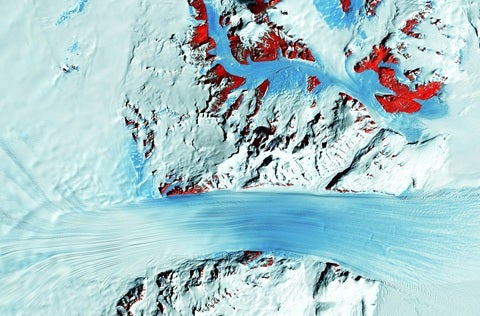
When tectonic plates break apart, the disruption does not stay neatly at the boundary. Research by Professor Thomas Gernon of the University of Southampton has shown that the separation can send slow-moving waves of instability spreading outward beneath the continental crust, a phenomenon known as mantle waves. These pulses travel at geological pace, advancing across the interior of a continent over tens of millions of years, pushing the surface upward as they go.
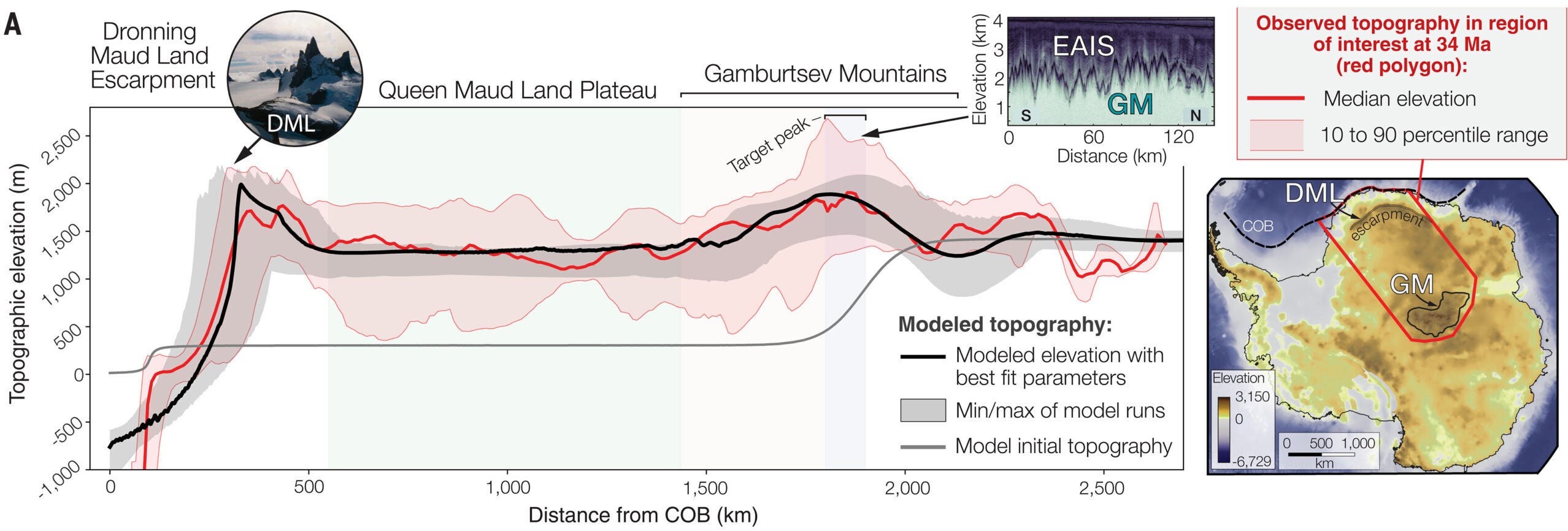
In Antarctica, that process had consequences that unfolded across an almost incomprehensible timescale. As mantle waves crept inward following the breakup with Africa, they progressively lifted the surface of East Antarctica, eventually building both a coastal escarpment and a high interior plateau crowned by the Gamburtsev Mountains, a range buried today beneath kilometers of ice.
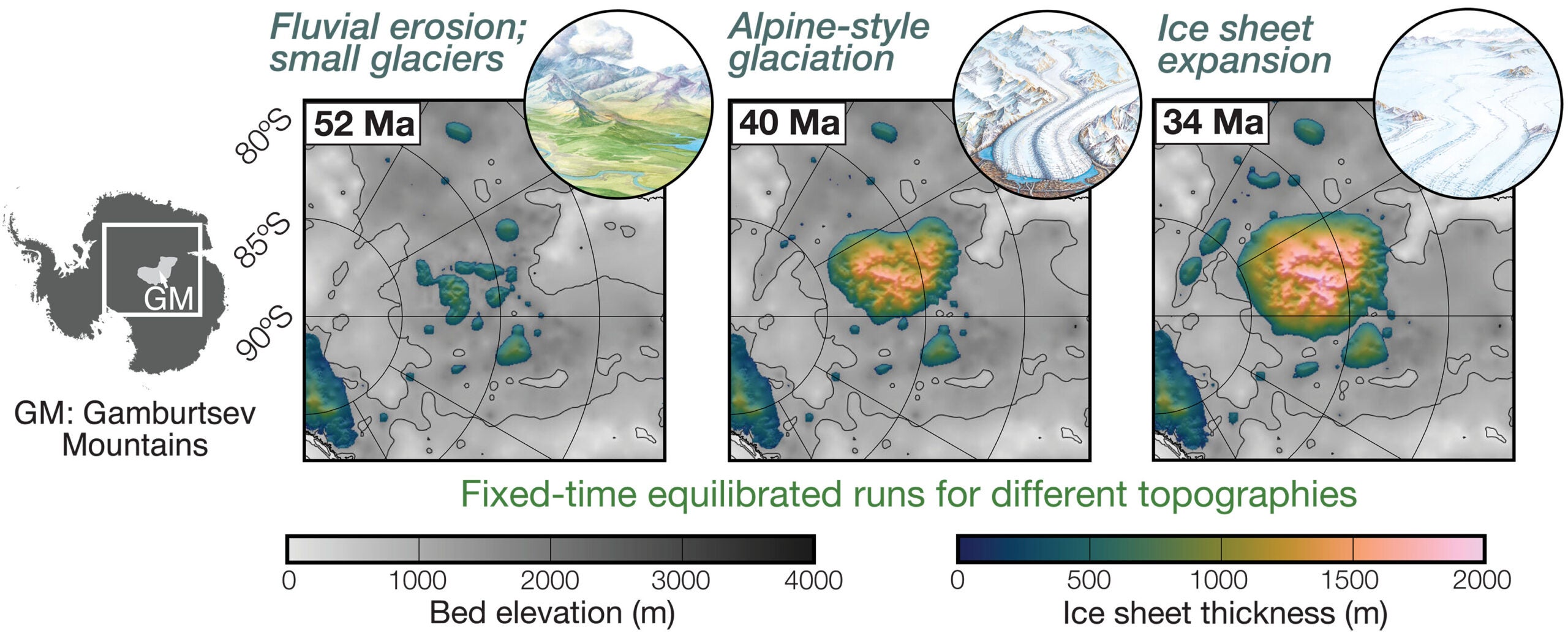
Before 50 million years ago, most of those mountains sat below 1.5 kilometers in elevation. By the time of Antarctica’s glaciation 34 million years ago, nearly half of the range rose above 2 kilometers, a threshold at which temperatures drop enough, and snow lingers long enough, for glaciers to take root.
“Antarctica’s land surface was gradually lifted to the point where ice could gain a permanent foothold, even while the surrounding polar oceans as well as global temperatures remained surprisingly warm,” said Gernon, who led the study.
The connection between altitude and ice is straightforward in principle but enormous in consequence. Air temperature drops by roughly 1 degree Celsius for every 100 meters of elevation gained. A mountain range that rises by a kilometer effectively moves its peaks into a climate zone that is 10 degrees colder, the difference between snow that melts each summer and snow that survives, compresses, and slowly becomes glacial ice.
Dr. Guy Paxman of Durham University, a co-author of the study, put it plainly: “Topography is fundamentally important for glaciation.”
Once ice begins to accumulate at elevation, it creates its own reinforcing cycle. Ice and snow are far more reflective than bare rock or open ocean, bouncing sunlight back into space rather than absorbing it as heat. Dr. Philip Goodwin, a climate physicist at Southampton and co-author, said the team estimates this feedback, called the ice-albedo effect, lowered global temperatures by roughly 1 degree Celsius as Antarctica frosted over.
Colder air carries less water vapor, which normally acts as an insulating layer around the planet. As that moisture declined with temperature, the insulating effect weakened further, letting temperatures fall still lower. Each effect fed the next, and the ice sheet spread from the mountains outward toward the coast.
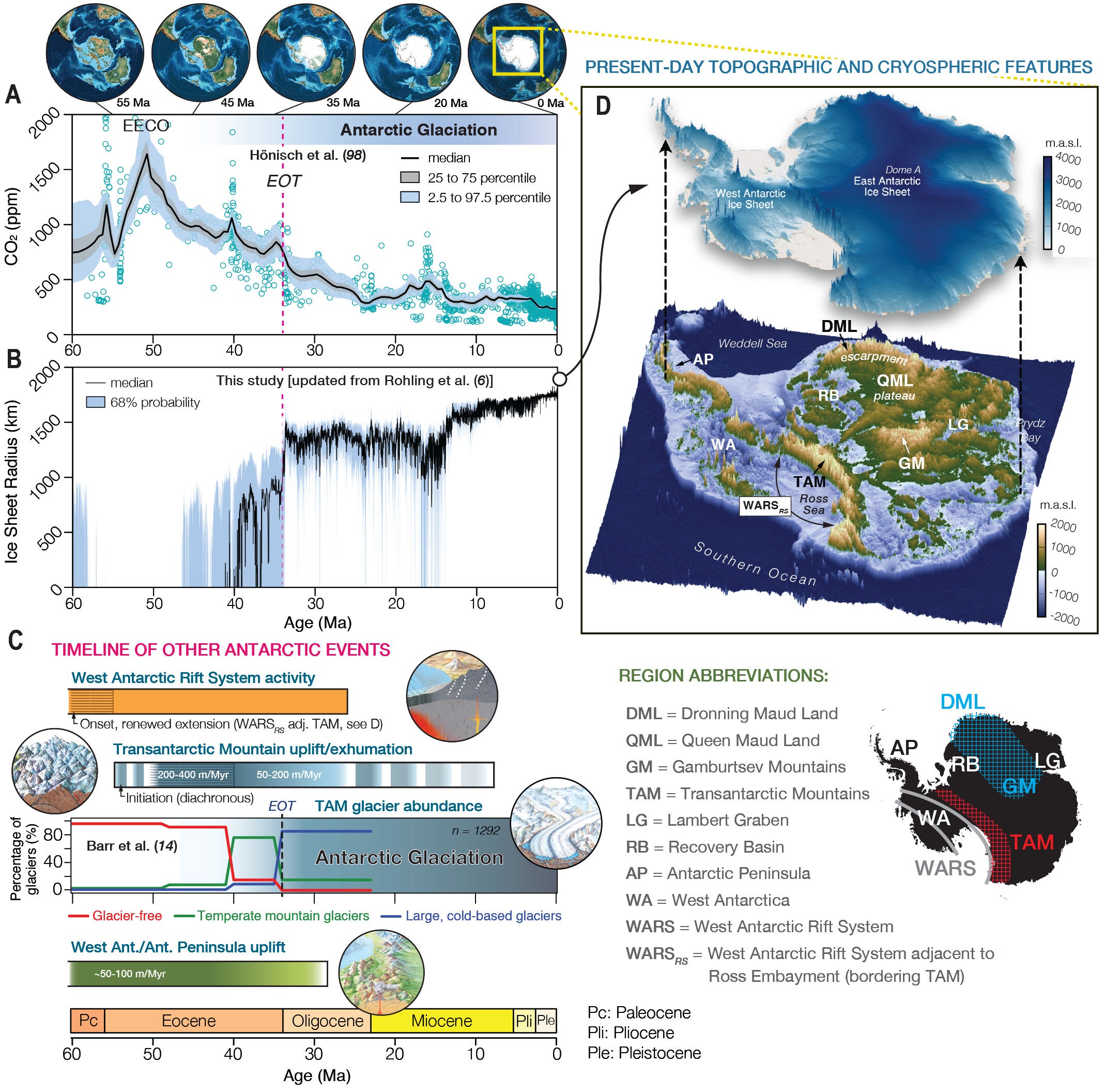
The research team used a combination of computational models to reconstruct how East Antarctica’s surface changed across 100 million years. A landscape evolution model tracked how erosion and mantle-driven uplift reshaped the terrain step by step. Those reconstructed topographies were then fed into an ice sheet model and a climate model to test whether the elevation changes alone were sufficient to seed glaciation, even with the climate held constant.
They were. The simulations showed that a topographic threshold was crossed somewhere between 50 and 45 million years ago, when enough highland area had risen above the permanent snow line to allow ice caps to nucleate and persist. The Gamburtsev Mountains went from having less than 5 percent of their area above 2 kilometers at 50 million years ago to more than 40 percent by 34 million years ago.
Dr. Thea Hincks, a senior research fellow at Southampton who co-led the study, noted that the models could realistically reproduce the coastal escarpment, elevated plateau, and interior mountains that characterize East Antarctica today, and track how each feature grew across deep time.
The Northern Hemisphere’s delay of roughly 20 to 30 million years in developing major ice sheets was not mysterious once the elevation factor was in place. The landmasses around the Arctic sit at much lower elevations. Without the geological lift that Antarctica received from its particular tectonic history, there was simply no high terrain around which mountain glaciers could form and coalesce into a continental ice sheet.
Carbon dioxide decline affected both poles. But CO2 alone, without the elevated ground to translate atmospheric cooling into permanent ice, was not enough in the north.
“If falling levels of CO2 acted alone, you would expect the poles to respond more symmetrically,” Gernon said. “Instead, Antarctica gained a major head start because geological processes had raised land to higher elevations, making it colder.”
That asymmetry now has an explanation rooted not in the atmosphere but in the deep, slow mechanics of the planet beneath one particular continent.
The East Antarctic Ice Sheet holds enough frozen water to raise global sea levels by roughly 52 meters if it melted entirely. Understanding the conditions under which it formed matters directly for assessing how stable it is under future warming, and what it would take to push it past a tipping point from which recovery might take millions of years.
More broadly, the study reframes how scientists think about the triggers of major climate transitions. The conventional model emphasizes atmospheric greenhouse gases as the primary driver. This research suggests that the planet’s interior, through geological uplift acting over vast timescales, can precondition entire continents for glaciation, effectively setting the stage long before atmospheric chemistry reaches the threshold that pulls the trigger.
That principle may apply beyond Antarctica. The researchers note that similar dynamics could help explain earlier glaciations in Earth’s history, including the Late Paleozoic Ice Age roughly 360 to 255 million years ago, when most of Earth’s landmasses were clustered in the Southern Hemisphere and, as now, the geography of elevation may have mattered as much as the chemistry of the air.
Research findings are available online in the journal Science.
The original story “Why Antarctica turned into an ice world millions of years before the Arctic” is published in The Brighter Side of News.
Like these kind of feel good stories? Get The Brighter Side of News’ newsletter.
The post Why Antarctica turned into an ice world millions of years before the Arctic appeared first on The Brighter Side of News.


Leave a comment
You must be logged in to post a comment.