Early eukaryotes, the lineage that later gave rise to animals, plants and fungi, may have depended on oxygen from the start. However, they mostly stayed on the seafloor. That narrow habitat could help explain why complex life took so long to spread widely.
The oldest widely accepted eukaryote fossils come from seas that were anything but inviting. Oxygen was scarce, the chemistry of the water shifted from place to place, and much of the ocean floor remained hostile to complex organisms. Yet in that patchwork world, a crucial branch of life appears to have found its footing.
A study in Nature argues that some of the earliest known eukaryotes, organisms in the domain that later gave rise to animals, plants and fungi, were already tied to oxygen between about 1.75 billion and 1.4 billion years ago. Moreover, the fossils also point to a more grounded lifestyle than many scientists had assumed. These organisms seem to have lived on or within the seafloor, not drifting freely as plankton in the water above.
That picture matters because the early history of eukaryotes remains one of biology’s deepest puzzles. These organisms are defined by traits such as a nucleus and other membrane-bound structures. Living eukaryotes also carry mitochondria, the energy-producing organelles long thought to be central to their success. But when those features appeared, and in what kind of environment they first proved useful, has remained disputed.
“There was also a conventional wisdom that all these early eukaryotes breathed oxygen and had mitochondria,” said senior author Susannah Porter, a professor in UC Santa Barbara’s Earth Science Department. “We wrote a couple papers saying, ‘Hey, not so fast. We might be looking at organisms that pre-date these features.’”
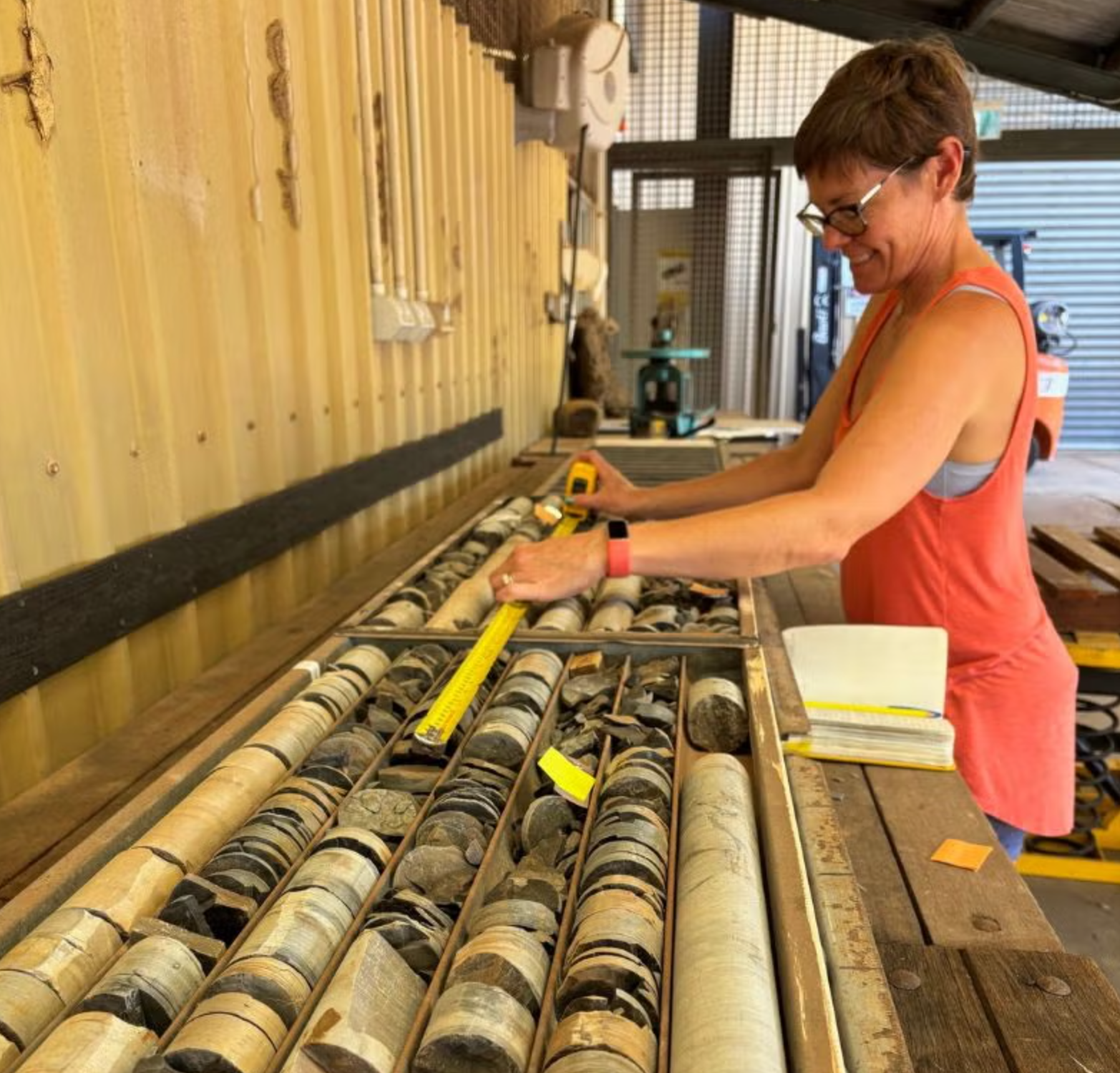
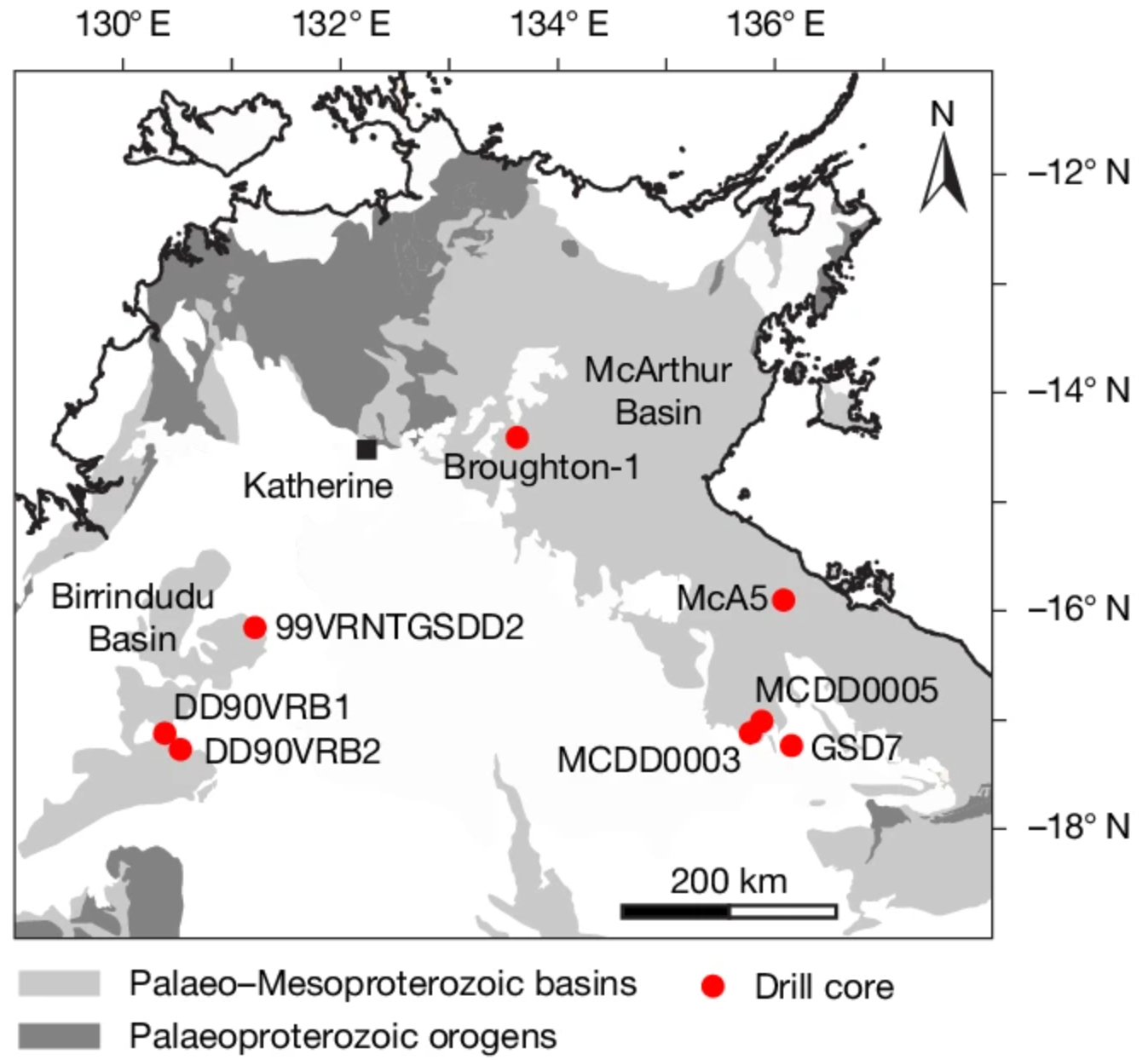
To test that debate, the team combined fossils, sedimentology and geochemistry from the McArthur and Birrindudu basins in Australia’s Northern Territory, where some of the oldest accepted eukaryote fossils have been found. Today the region includes savanna, outback and wetland. Yet in the interval studied it was a shallow inland sea with lagoons, coastal waters and offshore mud-rich settings.
The researchers examined mudstones from eight drill cores and sorted each sample into one of four depositional environments: coastal, lagoonal, shoreface and offshore. They then used iron speciation and trace element measurements to reconstruct whether the overlying water had been oxic or anoxic when those sediments formed.
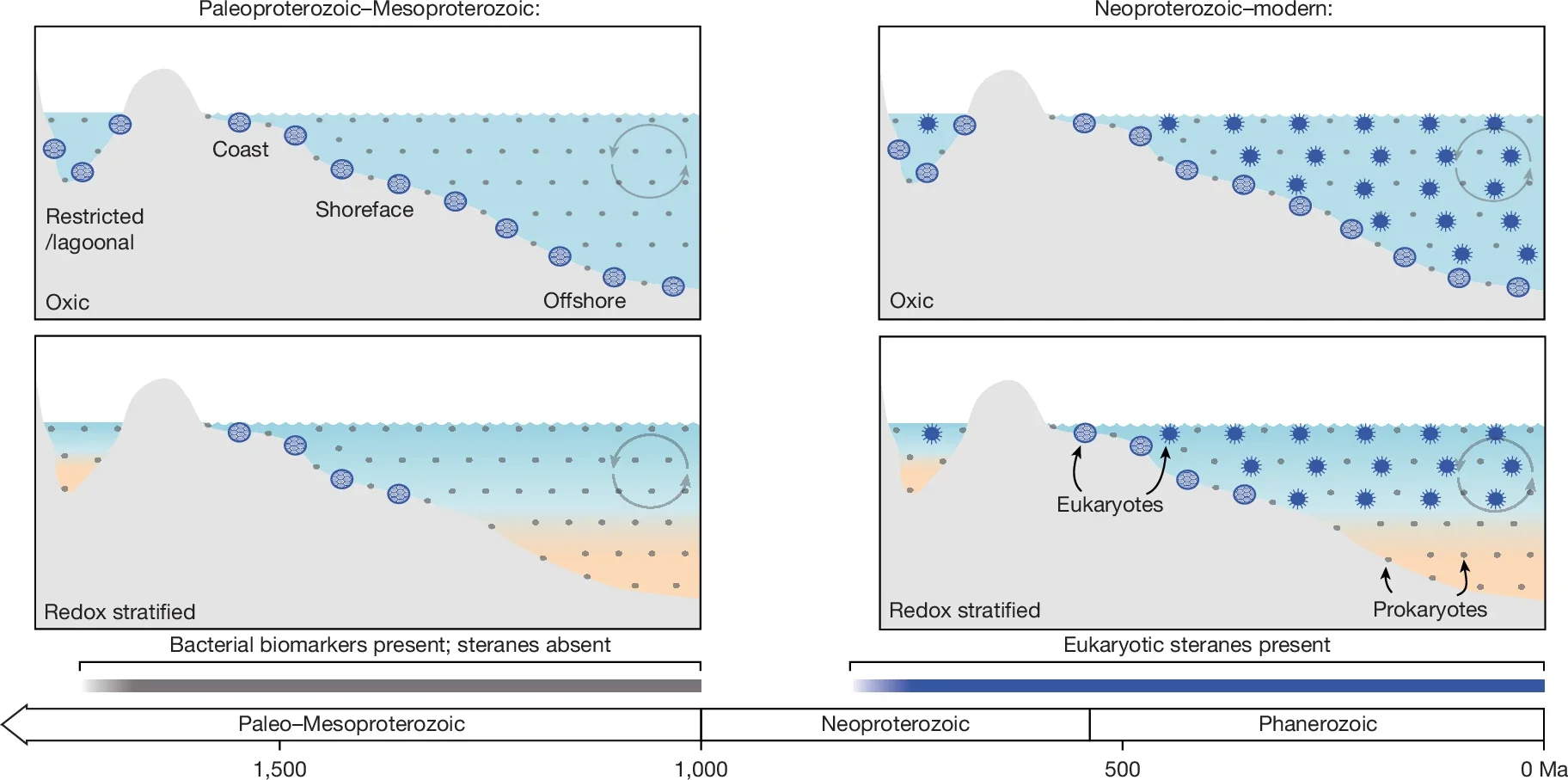
That distinction was central. In the Proterozoic oceans, oxygen was present, but not evenly distributed. Surface waters could be oxygenated while bottom waters remained oxygen-poor or even sulfidic. Atmospheric oxygen, Porter said, stood at 1% or less of modern levels. “We would not have been able to breathe,” she said.
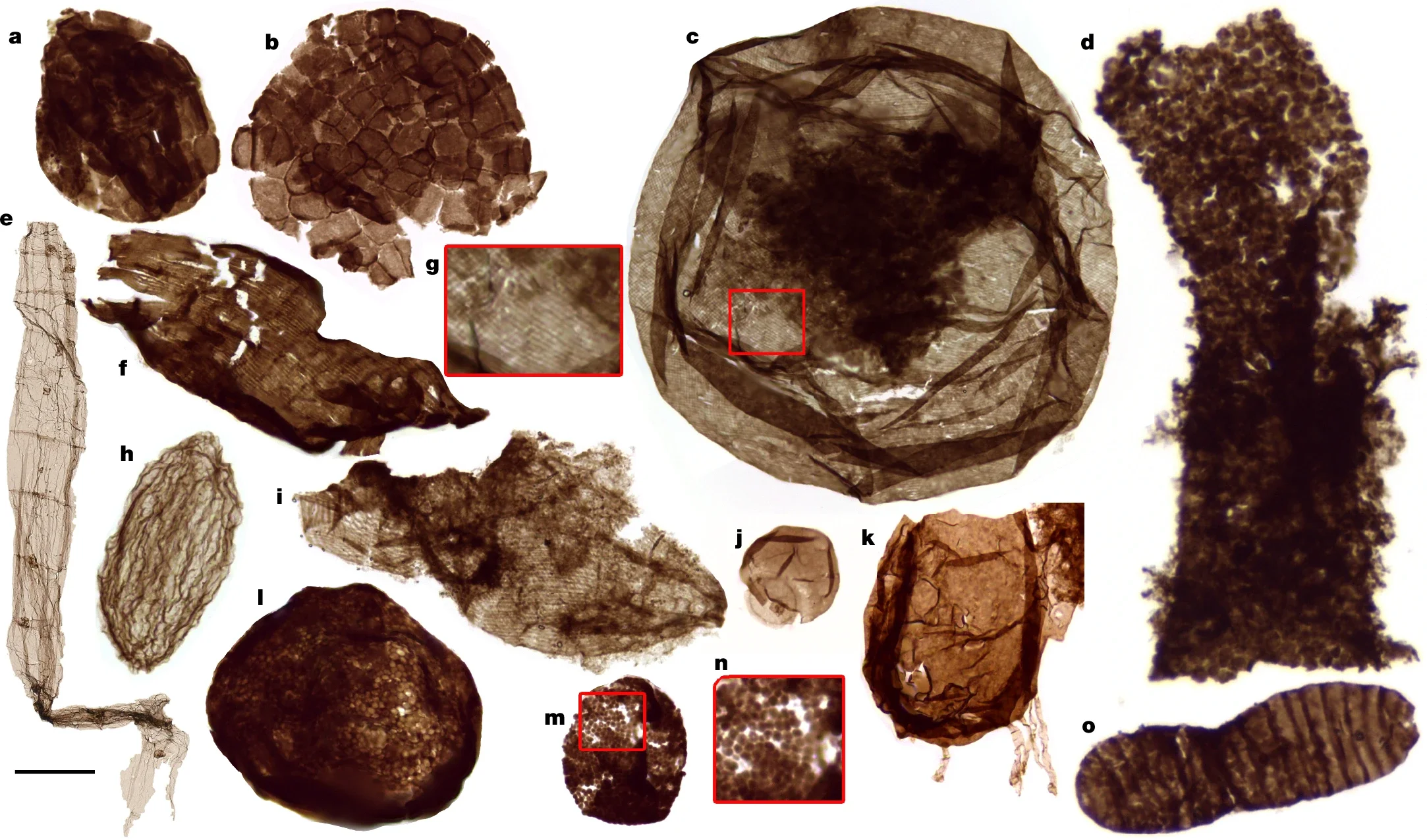
More than 12,000 fossil specimens were recovered from 87 samples. The team identified 14 eukaryotic species, 5 prokaryotic taxa and more than 13 taxa of uncertain identity. Some of the eukaryotes were assigned based on features not known from prokaryotes, including cellular extensions, lineations, plate-like external structures, operculae and, in one case, a large differentiated multicellular form.
The broad fossil recovery mattered because it showed the rocks were capable of preserving organic-walled microfossils across many settings. What changed sharply was the presence of eukaryotes.
Among fossil-bearing oxic samples, eukaryotes appeared in 32 out of 56, or 57%. In fossil-bearing anoxic samples, they appeared in only 3 out of 19, or 16%. The difference was statistically significant. Even though a few eukaryotic taxa did turn up in anoxic settings, those examples were rare and often fragmentary.
The overall pattern suggests that these early eukaryotes required at least some oxygen. Co-lead author Leigh Anne Riedman, a paleontologist at UC Santa Barbara, said the result changes the terms of the debate over whether the oldest eukaryotes could thrive without it. “We found that the oldest eukaryotes that we’ve seen so far already needed oxygen in some capacity,” she said.
The distribution also hints at where they lived. If these organisms had floated in oxygenated surface waters as plankton, their remains should have rained down into both oxic and anoxic sediments below. Instead, the fossils clustered in oxygenated seafloor environments. That is more consistent with benthic life, organisms living on or within the seabed itself.
“And we were able to figure out that they were living on or within the seafloor by the way they were distributed across the samples,” Riedman said.
That conclusion reshapes another long-running assumption. Early eukaryotes had often been pictured as plankton because many are microscopic and can resemble later drifting forms. But the new work suggests that morphologically complex eukaryotes may have remained largely benthic for a very long stretch of time.
That could help explain one of the oddest features of the fossil record: eukaryotes seem to have arisen far earlier than they became abundant or diverse. If they were confined to intermittently oxygenated seafloor habitats, their world would have been geographically restricted and ecologically narrow. In that case, low diversity is less mysterious.
“What’s striking to me is how restricted eukaryotes are at this time,” Porter said. “The surface water seems like such an obvious place to live, especially if they have to have oxygen; there’s lots of oxygen at the surface.”
The findings also support the idea that mitochondria were probably acquired early. Because all living eukaryotes possess mitochondria or reduced descendants of them, the timing of that acquisition has major evolutionary implications. The authors argue that if these fossils represent organisms already dependent on oxygen and showing notable morphological complexity, they likely had mitochondria by this point.
That would push the deeper process of eukaryogenesis, the long emergence of the eukaryotic cell, back toward or before the Great Oxidation Event roughly 2.4 billion to 2.1 billion years ago.
The study offers a possible explanation for another puzzle as well: the long delay between early eukaryotic body fossils and the later appearance of diagnostic sterane biomarkers, chemical traces associated with crown-group eukaryotes. If early eukaryotes lived mostly in oxygenated benthic settings, they may have been poorly represented in the organic-rich anoxic rocks most often used for biomarker studies.
Later, sometime in the Neoproterozoic, eukaryotes may have expanded more fully into the planktonic realm. That shift would have increased both their ecological reach and their odds of leaving a stronger fossil and biomarker record. It may also have helped set the stage for the rise in diversity and complexity seen closer to the end of the Proterozoic.
Porter noted that even the oldest fossils already look surprisingly varied. “So, although these are the oldest eukaryote fossils yet described, the diversity and variety of form achieved by this point suggest they have a deeper history,” she said.
The study does not just redraw an ancient habitat map. It changes where scientists may need to look for evidence of early complex life and how they interpret long gaps in the fossil and biomarker record. If the earliest eukaryotes were tied to oxygenated seafloor settings, then some past searches may have focused on the wrong rocks.
It also sharpens a larger lesson about evolution: major biological innovations do not always spread quickly, even when they seem powerful in hindsight. Early eukaryotes may have had oxygen use and probably mitochondria, yet still remained boxed into narrow habitats for hundreds of millions of years.
Understanding that delay could help explain how Earth moved from a mostly microbial planet to one filled with visible, multicellular life.
Research findings are available online in the journal Nature.
The original story “Ancient fossils suggest complex life got its start on an oxygenated seafloor” is published in The Brighter Side of News.
Like these kind of feel good stories? Get The Brighter Side of News’ newsletter.
The post Ancient fossils suggest complex life got its start on an oxygenated seafloor appeared first on The Brighter Side of News.

