Subduction zones can look permanent on a map. They run for hundreds or thousands of miles, haul oceanic crust into the mantle, feed volcanoes, and store the strain that drives some of Earth’s most dangerous earthquakes. But they do not last.
That basic fact has left geologists with a stubborn question. If subduction keeps pulling plates downward with such force, what actually stops it?
A new study points to an answer off Vancouver Island, where part of the Cascadia subduction system appears to be coming apart in real time. Instead of shutting down in one dramatic break, the research suggests, a subduction zone can fail by tearing itself into smaller pieces, losing strength segment by segment until the larger system grinds toward a halt.
“Getting a subduction zone started is like trying to push a train uphill, it takes a huge effort,” said Brandon Shuck, lead author of the study and an assistant professor at Louisiana State University, who conducted the research while he was a postdoctoral fellow at Columbia University’s Lamont-Doherty Earth Observatory. “But once it’s moving, it’s like the train is racing downhill, impossible to stop. Ending it requires something dramatic, basically, a train wreck.”
His team argues that in northern Cascadia, that wreck is not happening all at once.
It is unfolding one car at a time.
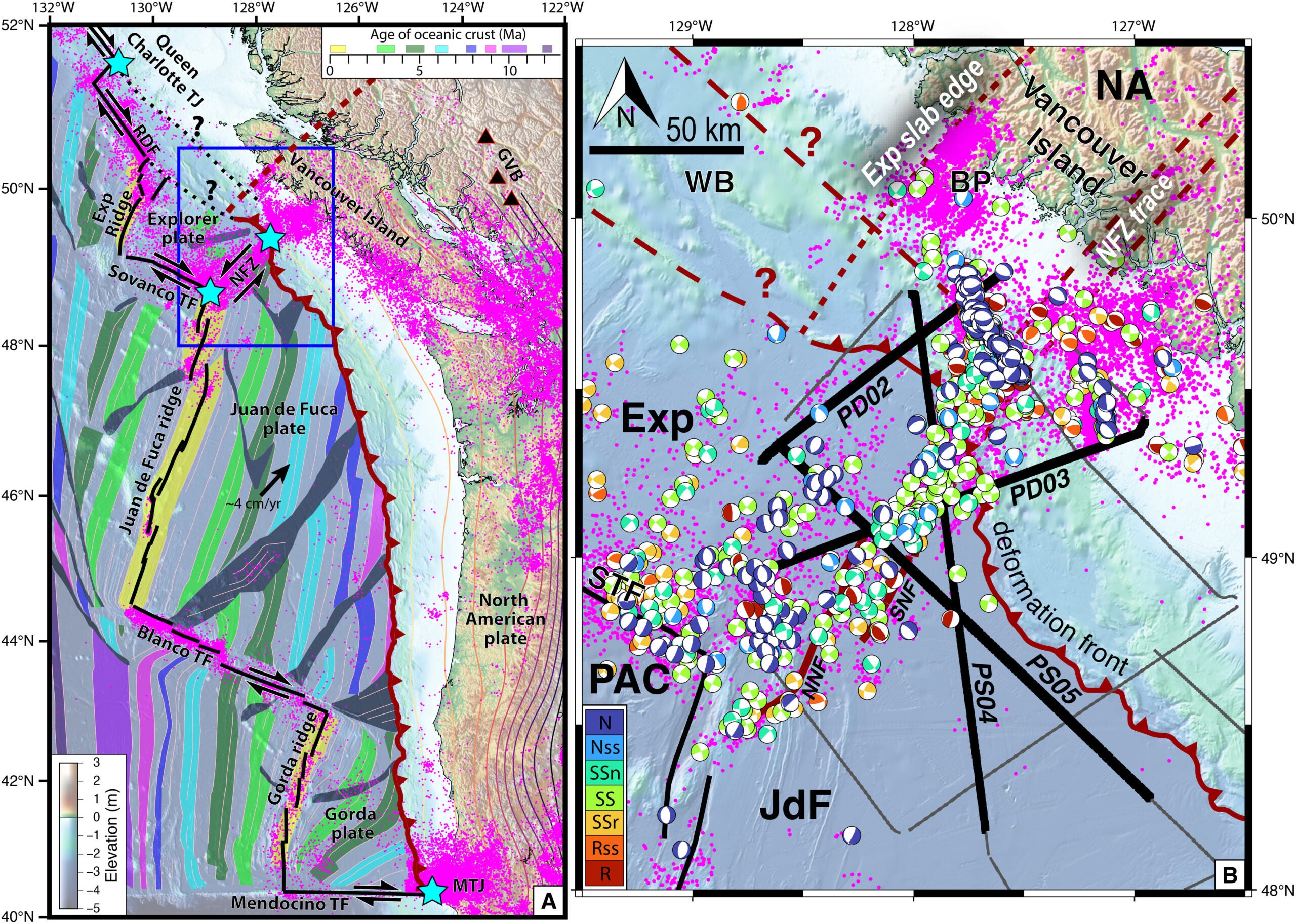
The study focuses on the northern end of Cascadia, offshore Vancouver Island, where the Juan de Fuca and Explorer plates are sliding beneath North America. This area is already tectonically complicated. The Queen Charlotte Fault, the Cascadia subduction zone, and the Juan de Fuca and Explorer ridges all meet there in a crowded plate-boundary setting.
That complexity matters.
The researchers say this region is actively undergoing subduction termination, the process by which a subduction zone ceases to function. In this case, they focused on a scenario in which a mid-ocean ridge approaches the trench. Because the nearby oceanic lithosphere is young, warm, weak, and relatively buoyant, it resists being forced downward and struggles to maintain the pull of the sinking slab.
To see what that looks like underground, the team combined deep seismic reflection images with regional earthquake catalogs and focal mechanism data. The seismic work came from the 2021 Cascadia Seismic Imaging Experiment, or CASIE21, conducted aboard the research vessel Marcus G. Langseth. Led by Lamont scientist Suzanne Carbotte, with co-author Anne Bécel, the experiment used sound waves sent into the seafloor and a 15-kilometer array of underwater sensors to capture their echoes.
The result was a detailed view into the crust, upper mantle, and downgoing slab.
“This is the first time we have a clear picture of a subduction zone caught in the act of dying,” said Shuck. “Rather than shutting down all at once, the plate is ripping apart piece by piece, creating smaller microplates and new boundaries. So instead of a big train wreck, it’s like watching a train slowly derail, one car at a time.”
The images show that the downgoing plate is not simply bending into the mantle. It is also breaking.
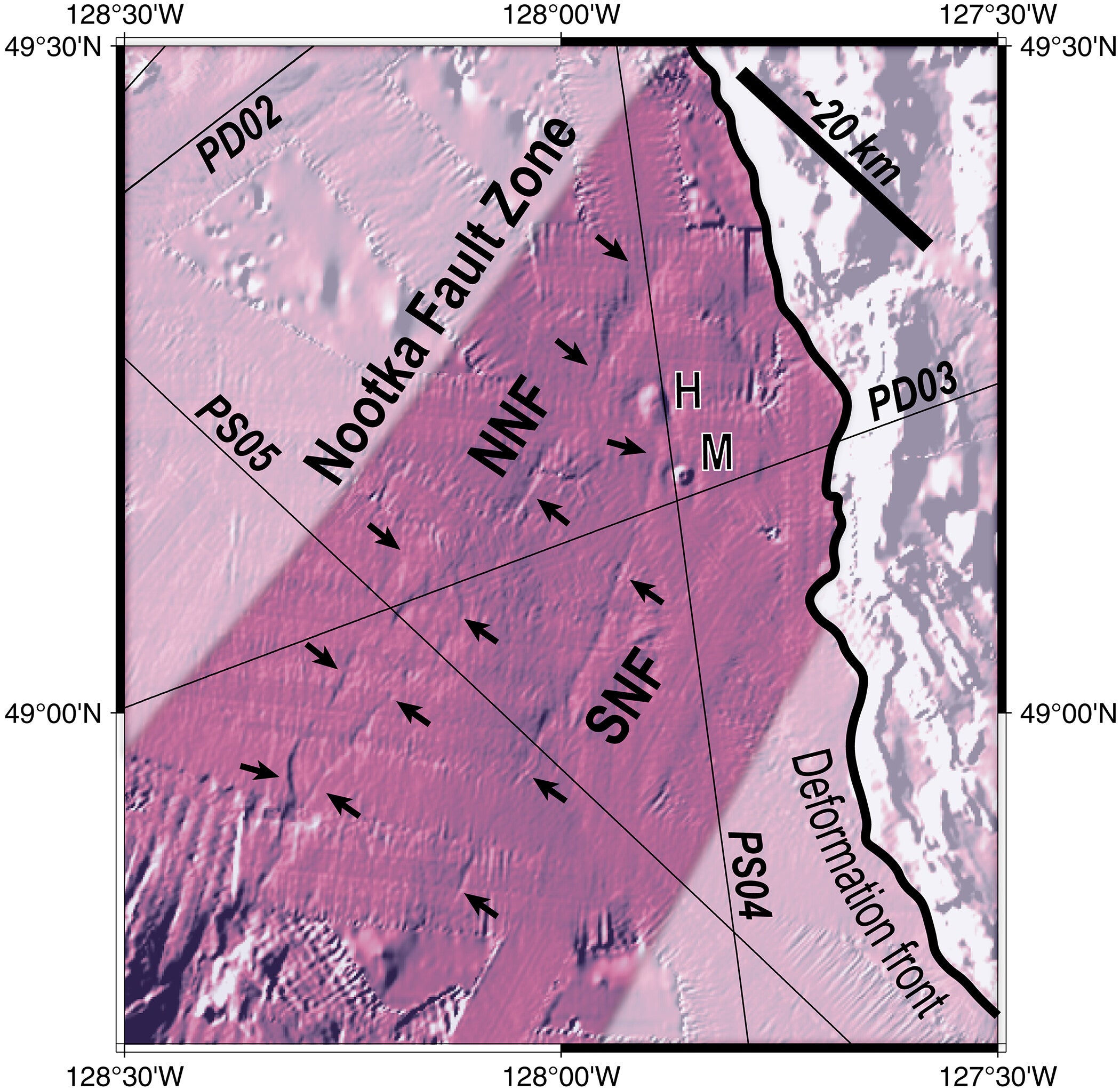
One of the most striking features lies in the Nootka Fault Zone, a belt of active deformation between the Explorer and Juan de Fuca plates. Seaward of the deformation front, the seismic profiles show a fault network about 20 kilometers wide, with fractures that cut through sediments, crust, and into the upper mantle.
Earthquakes cluster there too.
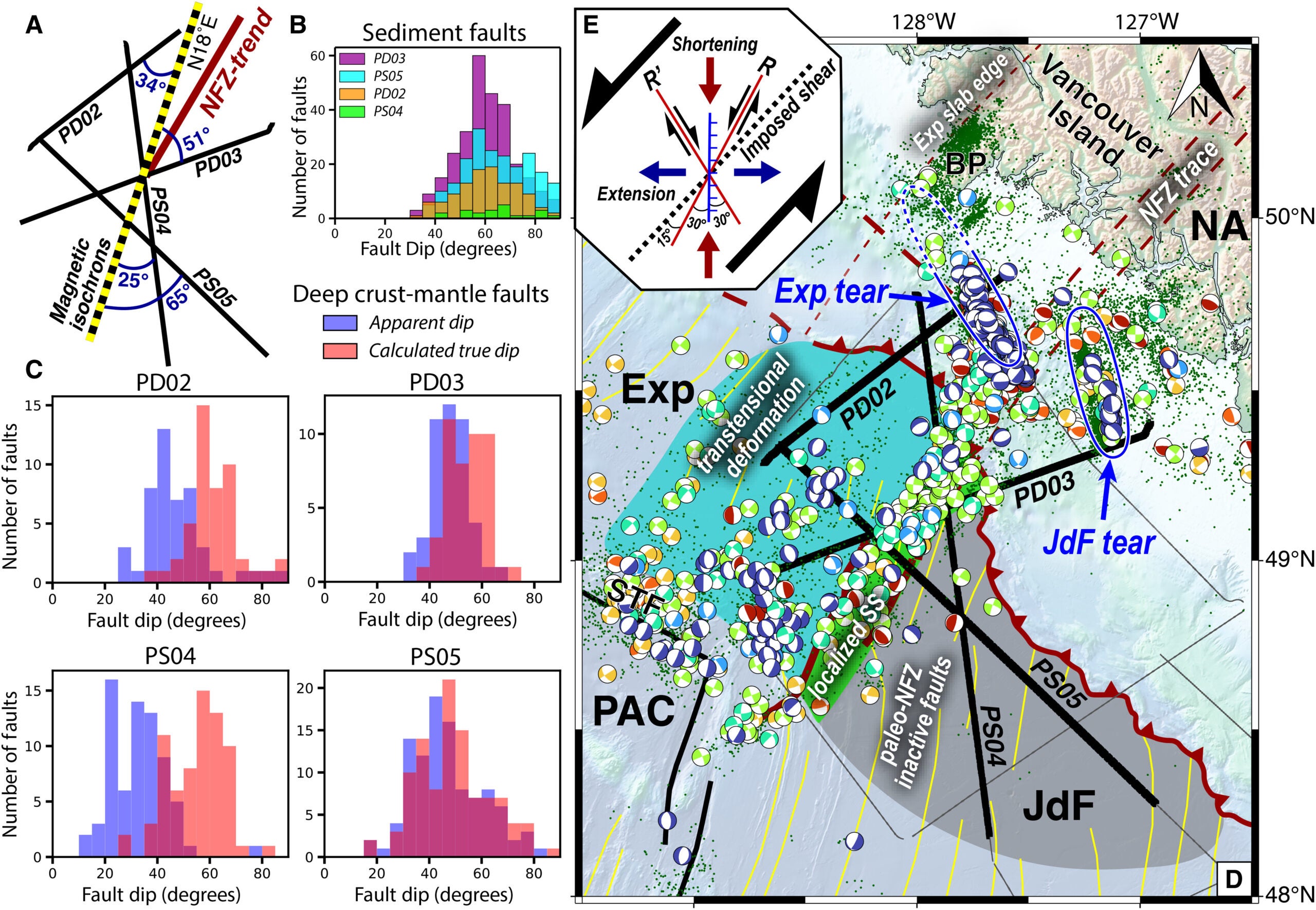
Some of those faults appear to be long-lived structures that once formed as normal faults near the spreading ridge, then were reactivated as the tectonic setting changed. The researchers found evidence that this older, broader shear zone later narrowed into the modern Nootka Fault Zone, which now acts as a transform boundary separating the two plates.
That transform boundary appears to be doing more than dividing motion at the surface. It may also be helping break the subducting slab below.
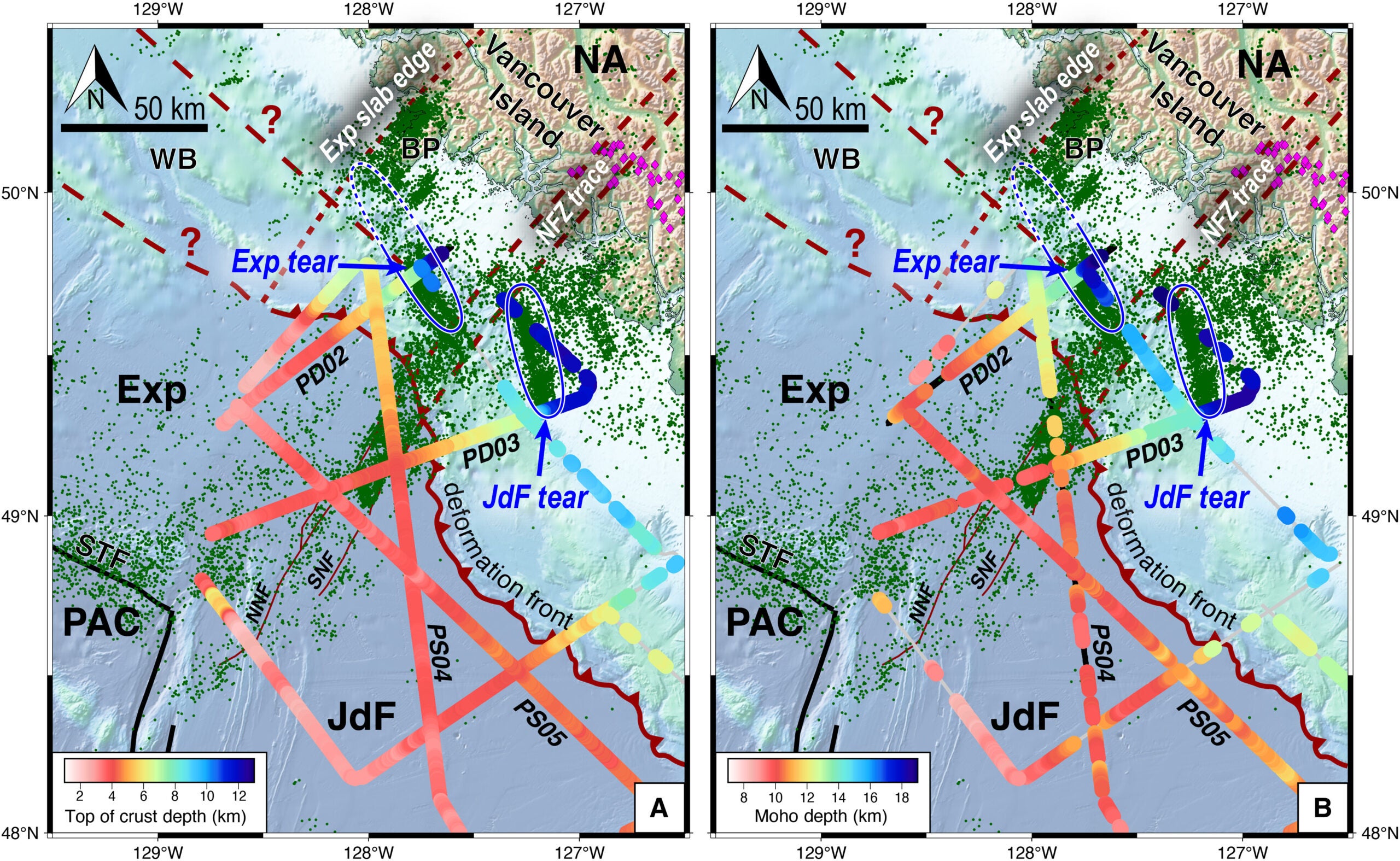
Landward of the trench, the team identified two major tears in the slab, one on the Explorer side and one on the Juan de Fuca side. Both coincide with earthquake lineations about 35 kilometers long and with drops in the top of the slab and the oceanic Moho. On the Explorer side, the break is abrupt. On the Juan de Fuca side, the slab bends more gradually.
The geometry suggests the two tears are at different stages.
The Explorer tear looks more mature, with a sharper vertical offset, deeper and steeper slab geometry, and focused seismicity forming a near-vertical wall. The Juan de Fuca tear looks less developed, with more distributed quakes and a broader buckle in the slab.
Shuck described one of the structures plainly: “There’s a very large fault that’s actively breaking the [subducting] plate. It’s not 100% torn off yet, but it’s close.”
That matches the earthquake pattern. Along a roughly 75-kilometer-long tear, some sections remain seismically active while others are oddly quiet. The quiet zones matter because once rock has fully separated, it no longer sticks and releases strain in the same way.
“Once a piece has completely broken off, it no longer produces earthquakes because the rocks aren’t stuck together anymore,” he said.
Those silent gaps suggest some sections may already have detached.
The broader argument of the paper is that subduction termination in this setting is episodic and piecewise. It does not happen as one continuous collapse along the trench. Instead, transform faults and slab tears divide the system into segments, allowing different parts to detach at different times.
That helps explain why the Explorer microplate appears partly decoupled while the adjacent Juan de Fuca plate continues to subduct more normally beneath North America.
Modern geodetic measurements show that convergence between the Explorer plate and North America is about 2 centimeters per year, much slower than the more than 4 centimeters per year seen for Juan de Fuca. The study links that slowdown to the evolving tear structure and to the Nootka Fault Zone, which helps isolate Explorer from the neighboring plate.
As smaller pieces break away, the larger plate loses the downward pull that keeps the whole system running. Over geologic time, that weakens the tectonic engine.
Carbotte said the findings offer an unusually direct view of a process that geologists have long suspected but struggled to document. “But we haven’t previously had such a clear picture of the process in action,” she said. “These new findings help us better understand the life cycle of the tectonic plates that shape the Earth.”
The work also suggests that transform faults may play a bigger role in ending subduction than previously recognized. In northern Cascadia, the Nootka Fault Zone appears to segment the plate, offset slab tears, and enable the formation of smaller fragments, including the Explorer microplate. The authors argue that this kind of transform-driven fragmentation may have helped shut down other subduction systems in Earth’s past.
That possibility reaches beyond Cascadia.
The study compares the modern northern Cascadia setting with the old Farallon subduction system that once extended beneath western North America. Offshore Baja California, geologists have found fossil microplates and abandoned ridge segments tied to the breakup of the Farallon plate. Those fragments have long hinted that ridge-trench encounters can terminate subduction, but the details were hard to reconstruct because the rock record is incomplete and old slab fragments are difficult to image.
Northern Cascadia offers something rare: an active example.
The authors suggest that the same step-by-step mechanism now visible near Vancouver Island may help explain the old microplates off Baja California. In both cases, subduction may have ended not through one clean rupture, but through repeated plate fragmentation, slab tearing, microplate rotation, and shifting plate boundaries.
The study also outlines a possible future for northern Cascadia. If the Explorer slab fully detaches, the region could develop a slab window, an opening where asthenosphere rises into the space left behind. The authors say that would likely shorten the Cascadia subduction zone by about 75 kilometers, roughly one-twelfth of its total length.
Still, some uncertainties remain. The researchers infer that the Explorer tear may extend from the Nootka Fault Zone toward Brooks Peninsula, but the northernmost seismic line did not go far enough landward to prove that directly. They also note that more three-dimensional geodynamic models are needed, especially for ridge-trench systems where the ridge is highly oblique to the trench.
They also raise questions about volcanism in British Columbia. Some volcanic fields have been interpreted as signs of upwelling through a vertical slab tear, but the propagation rate required by that explanation would be much faster than current models predict. An alternative is that the volcanism reflects mantle flow around the slab edge, enhanced by the slab’s ongoing fragmentation and decoupling.
For people living in the Pacific Northwest, the new work does not suddenly change the basic hazard picture. Cascadia still remains capable of producing very large earthquakes and tsunamis.
The study does, however, add important detail to how scientists understand the region’s mechanics. If major faults and tears segment the slab, they could influence how rupture spreads during future earthquakes and how seismic energy moves through the system. That kind of information matters for improving hazard models.
The findings also sharpen a much bigger picture. Subduction zones are not just born and maintained. They also age, weaken, and die. This study suggests that one path to that ending is not a single tectonic crash, but a drawn-out process of tearing, decoupling, and fragmentation.
That matters because plate tectonics depends on turnover. If subduction never stopped, continents would continue to merge, oceans would disappear, and the planet’s surface would lose much of the dynamic recycling that has shaped its history.
In northern Cascadia, researchers may now be watching the shutdown process as it happens.
Research findings are available online in the journal Science Advances.
The original story “The Earth is tearing itself apart near Vancouver Island in the Pacific Northwest” is published in The Brighter Side of News.
Like these kind of feel good stories? Get The Brighter Side of News’ newsletter.
The post The Earth is tearing itself apart near Vancouver Island in the Pacific Northwest appeared first on The Brighter Side of News.

